DePIN vs. Centralized Cloud: Who Is Really Winning the AI Compute War in 2026?
Explore DePIN vs. centralized cloud in the 2026 AI compute war. Compare cost, scalability, security, and the future of AI infrastructure.
Artificial intelligence has moved into a whole new technology. AI fashion in 2026 is bigger, more discreet, and vastly over-resourced than ever before. From self-sufficient AI vendors and enterprise coordinators to generative video systems and decentralized finance (DeFi) automation, modern AI workloads require an unprecedented range of computing power. Every advanced AI interface, whether serving employer users or customers, supports high-capacity labour capability.
For years, centralized cloud carriers dominated AI infrastructure. Companies depended on hyper-scale cloud infrastructure, private cloud environments, and universal cloud environments to gain the right to access GPUs, storage, networking, and scalable computing resources while addressing data security and statistical sovereignty needs, but, GPU infrastructure, infrastructure growth, and operational concerns about compliance have advised companies to rethink their AI strategies and come up with more flexible options, such as hybrid cloud architecture.
This is where the Decentralized Physical Infrastructure Network (DePIN) is transforming word-of-mouth exchange.
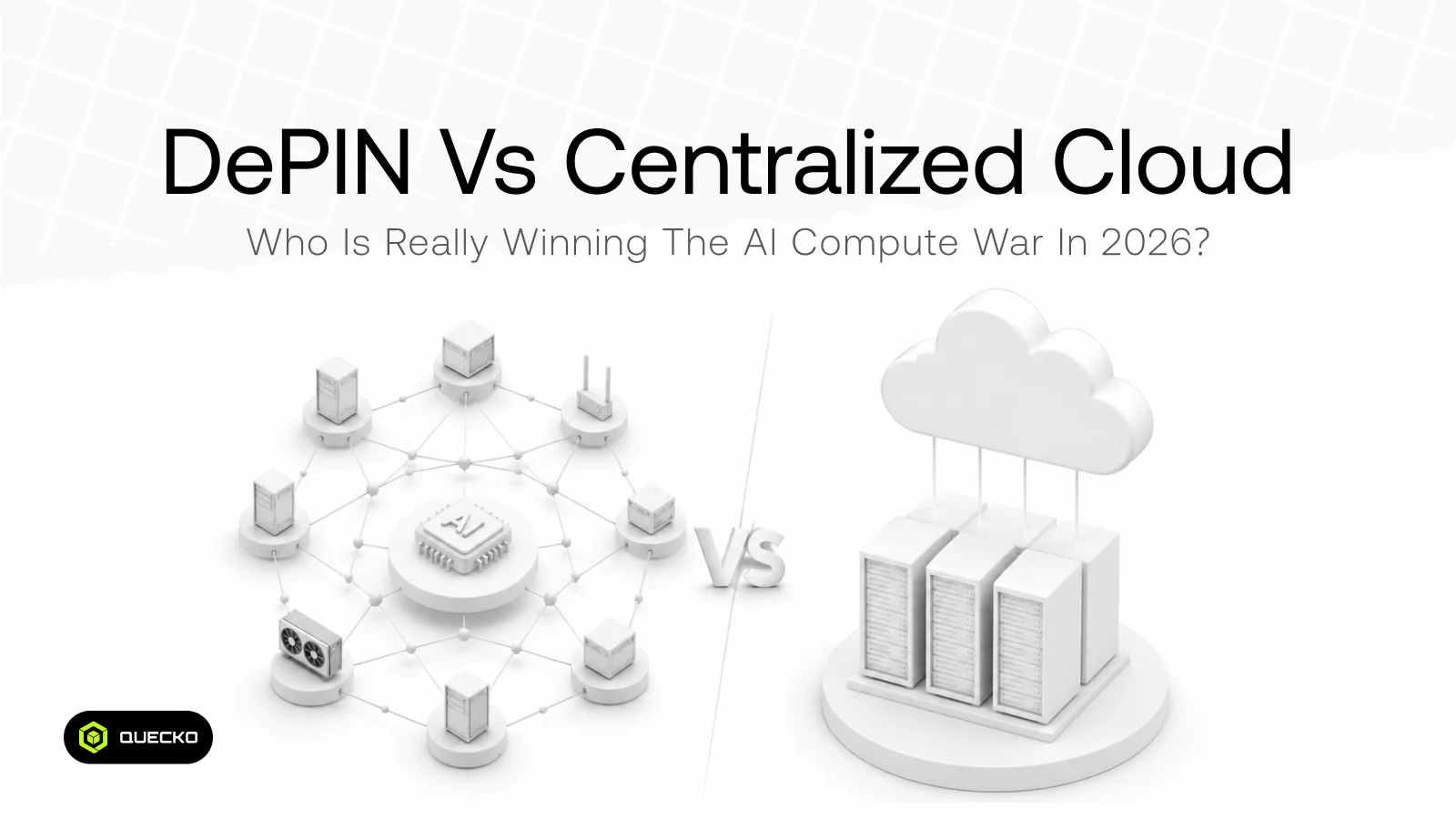
Rather than counting a handful of cloud carriers, DePIN distributes computing assets to many independent participants worldwide. Blockchain technology coordinates those assets through token incentives, which allows users to assign unused GPU power in a permissionless marketplace. This decentralized technology aids scalable predictive computing, empowers dedicated AI factories, and enables AI applications to roam on part machines requiring low latency and real-time selection without relying entirely on centralized infrastructure.
The question many companies, AI startups, Web3 projects, and buyers will be asking in 2026 is an easy one:
Can DePIN replace centralized cloud computing, or will traditional cloud vendors dominate AI infrastructure?
The reality is more nuanced. Instead of one generation replacing another, each trend is evolving rapidly—and AI-powered package-building companies need to know their strengths. Hybrid and cloud deployments can also diagram together to optimize overall performance, compliance, data assurance, and statistical integrity across a full range of AI use cases
As a blockchain development and marketing system, Quecko enables groups to explore decentralized technologies, token economies, AI integration, and blockchain infrastructure technologies to prepare them for this next technology of computing Whether companies are building enterprise AI platforms, implementing modern AI technology or delivering AI in the future, W knowledge needed to navigate through the rapidly evolving AI infrastructure panorama.
Understanding DePIN
DePIN stands for Decentralized Physical Infrastructure Networks. Unlike traditional cloud vendors that own and operate large data centers or private cloud and universal cloud environments, DePIN creates a decentralized marketplace where individuals and enterprises contribute physical hardware, including NVIDIA GPUs, CPUs, storage devices, party devices, AI bandwidth preloading, and large-scale version training and AI inference, Blockchain coordinates resource registration, identity verification, image sharing, payment agreement, popularity system, token incentives.
Instead of buying expensive GPU clusters or relying entirely on large AI factories like xAI’s Colossus, this makes AI buildings scable for more hardware for productive infrastructure and reduces reliance on centralized enterprises and develops a more flexible, fee-for-service environment for AI computing.
What Is Centralized Cloud Computing?
Centralized cloud computing is the version used by large cloud providers, which is highly owned by the large data centre and leases computing resources to customers .
These platforms include:
- Virtual Machines
- GPU Groups
- AI Education Infrastructure
- Managed Databases
- Storage
- Network
- Security offers
- Machine learning structure
The centralized cloud remains the backbone of agency AI because it offers:
- Predictable overall performance
- Corporate Compliance
- High Technology
- Professional Help
- Adult Tools
For many event-critical workloads, centralized infrastructure is still the default desire.
Why AI Compute Has Become So Valuable
Modern AI requires good computing assets. From AI model training to transformer prediction, state-of-the-art smart devices require a high-performance infrastructure capable of handling increasingly complex workloads. Large goal models require:
- GPU Groups
- High Bandwidth Networks
- Huge warehouse
- Ongoing Speculation
- Ability to fine-tune
AI startups typically spend thousands and thousands a year on compute, whether or not they deploy workloads to a private cloud or public cloud infrastructure. But the call for calls still exceeds supply, especially in innovation centers like Silicon Valley, where competition for GPU assets remains fierce.
The challenges are:
- GPU Flirting
- Infrastructure prices are rising
- Longer Acquisition Time
- Vendor Dependency
- Geographical Restrictions
As the use of AI increases, computer systems have become one of the world’s most valuable virtual goods. Decentralized systems incorporating sky networks are growing as opportunities by allowing distributed GPU markets that reduce costs and increase accessibility These networks also help on-chain revenue generation for pc vendors and allow static verification through Zero-knowledge certificates.
Industries beyond generative AI are increasingly implementing AI in agency workflows, industrial IoT, and advanced versions, all of which require scalable computing infrastructure. Coinciding with evolving concerns about power consumption and the global race to expand home AI chips, organizations are reshaping post-modular AI.
Why DePIN Is Growing So Quickly
Several market forces are driving DePIN adoption in 2026.
1. Better GPU utilization
Many companies have individual GPUs that take vast numbers of idle sessions per day. DePIN marketplaces monetize these untapped sources, turning idle hardware into a valuable revenue chain for retailers. Sky network platforms show how decentralized computing marketplaces connect GPU owners with AI makers in search of affordable infrastructure. This model supports both:
- GPU owners
- AI makers want cheap computer
As demand for large-scale AI programs grows, especially with projects like Colossus by xAI and advanced AI factories, maximizing GPU utilization has become an important priority.
2. Reducing infrastructure costs
Traditional hyperscaler cloud companies and private cloud deployments can be extremely valuable, especially for startups and research groups. Because DePIN sources bill globally, protests often result in more aggressive pricing and further cost control. Organizations benefit from having additional flexibility over ancillary budgets and access to AI infrastructure without significant investments in dedicated hardware.
3. Global Technology
Relying on a few centralized statistical centers, decentralized networks distribute the workload across thousands of independent nodes worldwide. This structure also helps with page computation, allowing AI packages to run closer to consumers through geographically allocated parts gadgets. The result is continued accessibility, reduced latency, and greater resilience to local outages.
4. Unauthorized Entry
Anyone with qualified hardware can contribute computer assets to the DePIN community. This democratizes ownership of infrastructure, rather than centralizing it among a handful of cloud giants. As governments increasingly invest in in-house AI chips and local computing infrastructure, decentralized participation allows for broader access to AI improvements, even as it reduces reliance on centralized providers.
5. Blockchain-based Incentives
Smart contracts mechanically compensate resource vendors through explicit blockchain transactions. Combined with zero-knowledge proofs of compromise, these systems can streamline privacy, establish computer integrity, and build trust by exposing sensitive data. A transparent token economy reduces administrative costs and encourages network growth.
In addition, decentralized infrastructure can improve power consumption efficiency using less consumed hardware than increasingly centralized facilities. Future advances in network technology with better optics are also expected to strengthen decentralized AI infrastructure by enabling faster, greener data exchanges across networks.
Strengths of Centralized Cloud
Despite DePIN’s rapid expansion, centralized cloud providers remain particularly strong. While decentralized GPU networks hold traction for AI workloads, many companies rely on traditional cloud infrastructure for their growth, predictable performance, and broad provider services. In many cases, companies may even take a private cloud approach to manipulate sensitive data as a public cloud source integration.
Mature Infrastructure
Cloud carriers have invested billions of dollars in:
- Network
- Data Centers
- AI Accelerator
- Monitoring
- Correlation
- Disaster Recovery
These mature ecosystems are difficult to replicate overnight. Their large infrastructure is often operated through strategically located hubs with access to reliable energy sources. Some hyperscale operators have even explored renewable energy options near key hydroelectric power stations, such as Grand Cooley Dam, to navigate the growing AI call while optimizing energy efficiency.
Business Security
Highly regulated industries need to:
- SOC Certifications
- ISO Requirements
- GDPR Guidelines
- HIPAA Compliance
- Corporate Governance
Centralized vendors already meet many of those needs. However, more and more DePIN structures introduce cryptographic authentication to increase transparency and allow customers to authenticate notebook execution without relying entirely on the trust of a central provider.
Reliable Performance
Dedicated Infrastructure Promises:
- Short Delay
- Transient Permeability
- Guaranteed Uptime
- Professional Follow
Large companies prioritize stability over experience. This is still a comprehensive advantage over many decentralized options, although large-scale projects like render networks increase reliability and workload computation through the distribution of AI rendering across global decentralized infrastructures.
Comprehensive AI service
Modern cloud systems provide integrated ecosystems, e.g.
- Ideal Education
- Managed Databases
- Data Pipelines
- Vector Database
- A. API
- MLops
- Monitoring
Businesses benefit from an all-in-one environment that simplifies the implementation of the best AI applications. At the same time, the ensuing era of AI, with vision, language, and action models for robotics, autonomous systems, advanced optics, and computer vision workloads, will require full-scale computing resources.
As DePIN ecosystems evolve, many platforms also develop sustainable monetary models through chain sales, worthy laptop companies also protect clear incentive mechanisms Industry opportunities including Render Con2026 additionally show growing momentum on the back of decentralized AI infrastructure, as AI can be resourced and how AI can be transformed.
Where DePIN excels
DePIN shines in situations where flexibility and decentralization are dependent.
Spend Optimization
Organizations can reduce infrastructure costs by accessing decentralized computing systems within your price range.
Efficiency in the GPU market
Instead of buying hardware that may be outdated, companies rent computing systems as needed.
Geographical Distribution
A distributed infrastructure allows workloads to move in a global direction of users.
Common Ownership
Infrastructure transport companies earn wages only by contributing to community life.
This creates more environmental participation than in a career-focused way.
Open Innovation
Developers can build AI packages without completely depending on an infrastructure provider.
This reduces vendor lock-in and encourages interoperability.
Challenges Facing DePIN
Where DePIN excels
DePIN shines in places where flexibility, decentralization, and cloud-native technologies count. By leveraging decentralized GPU networks, organizations can access scalable AI infrastructure while maintaining additional transparency and flexibility.
Spend Optimization
Organizations can reduce infrastructure costs by accessing decentralized computing within your device. As AI adoption increases, companies can also create new chain sales opportunities by collaborating in decentralized infrastructure ecosystems as opposed to relying solely on traditional cloud providers.
Efficiency in the GPU Market
Instead of buying hardware that may be outdated, companies rent computers on call through a network of decentralized GPUs. Platforms, such as the Render Network, highlight how distributed marketplaces can effectively make GPU vendors with AI workloads healthier, improve usable resource utilization, and reduce fees.
Geographical Distribution
Distributed infrastructure allows users to move workloads internationally, reduce latency, and improve application performance. This global structure is especially valuable for compute-intensive AI workloads involving advanced vision, language, and action models that require scalable and geographically allocated computing resources.
Common Ownership
Infrastructure providers earn rewards for supporting network growth. This creates stronger ecosystem participation than centralized ownership models and allows for transparent incentive mechanisms backed by cryptographic authentication, ensuring that computation and rewards can be executed securely.
Open Innovation
Developers can build AI applications without absolutely outsourcing an infrastructure company. This reduces vendor lock-in, encourages interoperability, and accelerates innovation using modern cloud-native technologies. Industry events like Render Con2026 likewise highlight how decentralized AI infrastructure is evolving, bringing together manufacturers, researchers, and enterprises to improve the future of decentralized computing.
Developers can build AI applications without relying entirely on an infrastructure provider. This reduces agent lock-in, encourages interoperability, and accelerates innovation using state-of-the-art cloud-native technologies. Industry opportunities including Render Con2026 further shed light on how decentralized AI infrastructure is evolving, collectively engaging developers, researchers, and enterprises to develop the destiny of decentralized computing.
Challenges Facing Centralized Cloud
Centralized suppliers also face increasing stress.
Rising costs
AI keeps infrastructure costs up.
GPU calls often exceed supply.
Vendor Locking
Moving between cloud vendors can be high-priced and technically difficult.
Infrastructure Concentration
Global AI is tightly dependent on very few oversized vendors.
This focus increases concern for flexibility and resilience.
Data Protection Officer
Organizations seeking greater control over where data is processed and stored.
The Hybrid Future
Rather than choosing one version exclusively, many companies are adopting hybrid strategies.
Examples are:
- The training base is fashioned on a centralized cloud .
- DePIN runs assessments on networks
- Using a decentralized garage with an agent cloud
- Combining Aspect Computing with Cloud Infrastructure
- Scale workload redundancy through decentralized GPU marketplaces
A hybrid structure provides greater flexibility in balancing fees, performance, and compliance.
Blockchain’s Role in AI Infrastructure
Blockchain doesn’t always change GPUs, it syncs them away.
Smart contracts allow:
- Resource Discovery
- Automated Invoicing
- Reputation Monitoring
- Identity Proof
- Utilization Audit
- Transparent Billing
These talents and growing trust also reduce friction between laptop buyers and carriers.
Token Incentives Power DePIN Networks
Unlike centralized carriers that maintain platform sales, DePIN ecosystems instantly evaluate contributors.
The brand encourages:
- GPU vendors
- Warehousing Companies
- Network Credentials
- Developers
- Infrastructure Driver
Well-designed tokenomics encourages the development of a sustainable environment by means of the alignment of incentives among supporters.
Real-World Use Cases
The DePIN-powered AI infrastructure helps:
- Generative AI startups
- AI Assessment Offerings
- Acquiring the Knowledge Machine of Research
- Autonomous AI agents
- Scientific Simulation
- Decentralized Performance
- Healthcare Analytics
- Financial Modeling
- Blockchain Analysis
- Edge AI Deployments
As those packages get bigger, decentralized computing will be an increasingly valuable complement to traditional cloud services.
Business Considerations Before Choosing
Organizations benchmarking AI infrastructure should not forget:
- Workload Characteristics
- Budget
- Compliance Requirements
- Expectations of Stay
- Geographic Scope
- Security Policy
- Scalability
- Vendor Agility
- Integration Complexity
- Long-term operating costs
The optimal solution depends on the balance of these elements in favor of deciding on a conventional infrastructure version.
How Quecko Helps Businesses Navigate the AI Compute Revolution
The development of AI infrastructure creates opportunities for companies that are embodying decentralized technologies. But fulfilment requires more than just choosing a platform; it requires a proper structure, token strategy, blockchain integration, and marketplace .
Quecko enables organizations to bridge this gap through blockchain development and Web3 advertising services.
Whether you are launching a DePIN marketplace, integrating decentralized GPU networks into AI applications, growing smart contracts, or fashioning token-based incentives, Quecko provides the technical expertise that would accelerate improvements.
Beyond engineering, Quecko additionally helps job growth through branding, network building, content marketing, SEO, environmental partnerships, and investor-focused marketing strategies. This kit enables blockchain and AI businesses of any size in a technologically and commercially increasingly competitive marketplace.
By aligning modern technology with powerful market execution, Queco empowers companies to confidently participate within a subsequent era of decentralized AI infrastructure.
Who Is Really Winning the AI Compute War in 2026?
The solution is not always as simple as declaring an unmarried winner.
Centralized cloud providers maintain their mature infrastructure, reliability, and quality of service to dominate the path in organization extensions, enterprise-critical systems, and specially regulated industries.
Meanwhile, DePIN has positioned itself as a transformative push through unlocking underutilized GPU resources, lowering infrastructure fees, expanding global access to computing, and promoting net-push ownership.
Instead of transforming a centralized cloud system, DePIN enhances the panorama of AI infrastructure. Evolving trends point to a hybrid architecture where organizations leverage a centralized cloud for temporary enterprise workloads while using a decentralized network for scalable, cost-efficient computing systems.
The real winners are organizations that find a way to strategically combine each method. By embracing flexibility, reducing vendor dependency, and integrating blockchain-powered infrastructure where it promises value, companies can build flexible AI systems designed for the future.
As AI adoption increases, computer systems will become one of the world’s most valuable resources, and every centralized cloud company and DePIN network will play a critical role in powering the next wave of innovation.
Frequently Asked Questions (FAQs)
1. What is DePIN?
DePIN (Decentralized Physical Infrastructure Network) is a blockchain-powered model that coordinates physical assets with GPUs, garages, bandwidth, and computing hardware through a decentralized network using smart contracts and token incentives.
2. How does DePIN differ from centralized cloud computing?
The centralized cloud is based on proprietary infrastructure using large vendors, while DePIN resources compute global resources from allocated contributors, creating a decentralized marketplace for AI computing.
3. Can DePIN upgrade traditional cloud companies?
Not quite. By 2026, DePIN is considered more of a complementary solution that provides cost-green, decentralized computing with the reliability and employability capabilities of centralized cloud infrastructure.
4. Why is AI computing important in 2026?
Advanced AI fashions require good GPU resources for training and inference. As the use of AI grows, scalable, low-cost computing technology to generate revenue has eliminated a key competitive advantage.
5. What are the main blessings of DePIN?
Key benefits include reduced infrastructure costs, improved GPU utilization, worldwide accessibility, reduced vendor lock-in, transparent blockchain-first based interoperability, and community-driven infrastructure ownership.
6. What demanding situations does DePIN face?
DePIN faces challenges including network scalability, hardware reliability, regulatory uncertainty, and achieving consistent overall performance across its distributed infrastructure.
7. Is centralized cloud relevant anyway?
definitely. Centralized cloud vendors remain critical to enterprise AI, providing mature ecosystems, high reliability, robust protection, compliance certifications, and comprehensive managed services.
8. What is the fate of AI infrastructure?
Destiny is becoming more and more hybrid. Businesses are expected to blend centralized cloud services with decentralized computing networks by choosing the most appropriate infrastructure based on workload, performance, compliance, and cost requirements.
9. How does blockchain help DePIN?
Blockchain enables decentralized coordination through smart contracts, clear billing, identity verification, reputation structure, usage tracking, and automated aid distribution
10. How can Quecko help organizations adopt DePIN and AI infrastructure?
Quecko provides blockchain optimization, smart contract engineering, tokenomics consulting, AI blockchain integration, DePIN platform optimization, Web3 advertising and marketing, search engine marketing, branding, to help companies build and scale decentralized AI solutions properly. and provides community-building services.
Author

Sheeba Abbasi
Digital Marketer and Social Media StrategistHi! I'm Sheeba Abbasi, a Digital Marketer, Social Media Strategist, and Content Creator specializing in Web 3.0 and Blockchain, with expertise in content development, community engagement, strategic planning, and technical writing.

Date
4 months agoShare on

Related Blogs

Beyond Endorsements: Why Equity-First Models Are Redefining the Player-Owned Economy
5 days ago
Modular Blockchains Are Killing Monolithic Chains — Here’s Why Rollup Stacks Are Winning in 2026
7 days ago
USDT vs USDC: Which Stablecoin Is Better for Enterprise Digital Infrastructure in 2026?
11 days ago

How Businesses Use Stablecoins for International Transfers
14 days ago