How Businesses Use Stablecoins for International Transfers
Businesses move money across borders, but traditional banking can make the system slower, costlier, and harder to manage within regulatory compliance frameworks. A dealer may also wait days for budget while finance teams juggle numerous currencies and navigate the requirements of various jurisdictions. Stablecoins offer another route. Most digital currencies can maintain their value, which […]
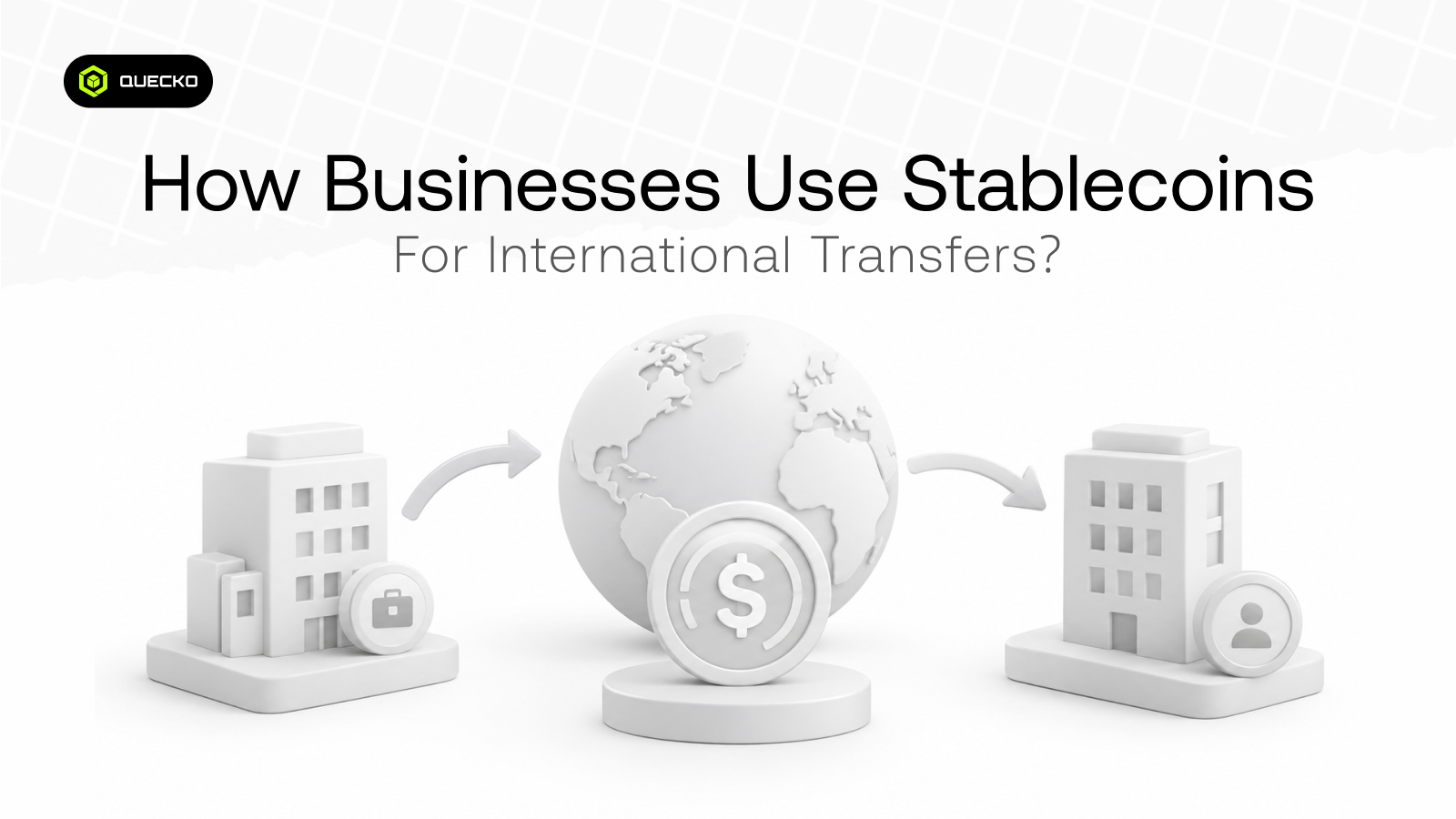
Businesses move money across borders, but traditional banking can make the system slower, costlier, and harder to manage within regulatory compliance frameworks. A dealer may also wait days for budget while finance teams juggle numerous currencies and navigate the requirements of various jurisdictions.
Stablecoins offer another route. Most digital currencies can maintain their value, which is mostly stable, by tying them to one of the fiat foreign currencies, like the US dollar. Since those are blockchain-based, companies can utilize them to pay suppliers internationally, send foreign currency, make treasury transfers, and carry out other international financial operations.
What Are Stablecoins and How Do They Enable Fiat Currency-Backed International Transfers?
These digital currencies which are based on blockchain are referred to as Stablecoins are meant to stabilize the extreme price fluctuations characteristic of other cryptocurrency assets. Fiat-backed stablecoins are digital currencies tied to the value of traditional money, like the US dollar. Its value is directly related to the currency or the reserve asset. The key feature which allows using stable coins in cross-border payment systems is their value stability. That’s the key factor that makes them a good choice for sending money across borders. When a company wants to send money overseas, it can avoid dealing with changing exchange rates during the transfer by sending the money as a dollar-backed payment. This way, the value stays stable, and they don’t have to worry about losing money as currencies go up and down.
In this way, finance companies also get a better record of each payment that can make the reconciliation across different currencies and markets a simpler matter. By moving value among wallets on a blockchain network, a stablecoin cross-border transfer works as an alternative to settling international bills for a company without totally relying on correspondent banking.
For companies that regularly do stablecoin international transfers, the combination of these benefits, that is price stability, transaction transparency, and faster settlement, will be a big improvement in their operations.
Why Sending Money Across Borders Can Be Difficult for Businesses?
Traditional payment systems typically rely on banks, intermediaries, FX providers, as well as the local banking rails. Though payment instructions are transferred via financial establishments via the SWIFT machine, but there is a small fraction of transactions which settle using the same.The correspondent banking system is on the center of this gadget owing to the reason that this is carried out via sending fee instructions thru networks which particularly involve Nostro accounts and pre-funded balances. The whole setup is quite an operational burden as well as a working capital lockup for the participating parties.
For businesses comparing stablecoin international transfers, expertise in these constraints provides an explanation for why blockchain-based alternatives are gaining traction. When payments ought to skip through multiple correspondent banks, the end result is frequently not on-time settlement, complicated reconciliation, and higher costs. Stablecoin global transfers can lessen a number of those middleman steps, but they no longer eliminate the need for traditional infrastructure totally. Local banking rails, overseas money conversion, and regulatory compliance remain vital components of any bypass-border price manner, even when the center charge transfer takes place on a blockchain.
Even though enterprises prefer using stable coin payment methods instead of existing charge payment systems for transferring funds internationally, there is a probability that local withdrawal policies, compliance policies, and foreign exchange rates would still depend on the same underlying financial structure that they were initially hoping to avoid. Instead of removing it completely, stablecoin payments tend to be most beneficial when they work in tandem with it; one handles the blockchain settlement, while the other tackles the local disbursement and regulatory requirements. For finance teams dealing with everyday go-border activity, recognising wherein stablecoin global transfers suit inside the broader price stack is a vital step before committing to any new price infrastructure.
How Stablecoin International Transfers Work?
A stablecoin payment may pass through several digital wallets before reaching the person or business it is meant for. Blockchain explorers permit companies to view transaction data and verify that a switch has been processed.
Smart contracts can automatically execute payment terms, while the payment carrier can manage currency conversion and ultimate disbursement. This means blockchain settlement can become one part of a broader payment infrastructure.
Stablecoins do not remove banks from the process. A firm may also need to have accounts in fiat currency at the banks, have its currency converted, and make payments through local systems.
Choosing the Right Blockchain Network for Stablecoin International Transfers
Once the organization begins to make cross-border payments using stablecoins, choosing the right blockchain community becomes crucial.
A network with low fees might be appealing for businesses that make frequent transactions on the blockchain. On the other hand, a well-established public blockchain could provide more extensive support within its ecosystem. In case of the use of blockchain to make payments, corporations have to take care of matching the network they would like to use and the payment system currently used by them.
Security is another major concern. Companies should always verify wallet addresses double, do payment process tests, and make clear rules for handling failed or misdirected transactions. Blockchain transactions, after being confirmed, are extremely hard, if not practically impossible, to reverse.
Hence, opting for the cheapest network may not necessarily be the best choice. Enterprises need to balance the cost factor against the reliability, liquidity, and compliance requirements aspects to arrive at a choice of a network that will be able to continuously process their payments in different locations and in different currencies.
Faster Settlement for Businesses
Companies are attracted to examining inter-country payments using stablecoins largely because of speed. The regular bank transfer is strictly dependent on the banking hours, weekends, holidays, and the financial intermediaries’ checks. Any payment that gets made on a given day, for example on a Friday, may not get to its destination till after several days.
Contrastingly, unlike blockchain transactions, bank transfers are subject to banking hours and holidays. A business that frequently makes transnational payments might find its suppliers getting the money a little sooner and their cross-border cash flow being handled more effectively.
McKinsey projected that in 2025, real stablecoin payment volumes would total roughly $390 billion, of which about $226 billion would be B2B payments. These approximations make a division between actual payment activity and the overall volume of blockchain transactions, indicating through quicker settlement the way companies are rearranging their cross-border payments and dealing more generally with international money transfers.
Lower Costs and More Efficient Payment Rails
When making cross-border payments, organizations regularly face diverse costs like switch prices, charges from intermediaries, and fees associated with forex conversion. For agencies that often pay suppliers in remote places, those costs can add up fast. Stablecoins might mitigate a bit of this issue by leveraging blockchain payment systems rather than the entire dependence on conventional bank methods. They could bypass some of those middleman steps, which result in not only additional costs but also delays.
Nevertheless, companies should look at all different kinds of associated expenses such as network charges, conversion fees, legal costs, and even local payouts if they want to go with stablecoins as their global payment method. Payments to suppliers that may seem less expensive are still subject to conversion or local payout charges depending on the receiving country. Finally, total expenses are determined based on payment method, country, and payment partner.
Supplier Payments and Global Supply Chains
Stablecoin worldwide transfers can provide a practical alternative when suppliers operate across different currencies and banking systems. Rather than routing payments through multiple correspondent banks, a business can send funds directly to an eligible provider using a dollar-backed stablecoin, reducing intermediaries and making transactions easier to track.
For global supply chains, this flexibility can be valuable. A supplier can receive a stablecoin, convert it into local currency through a service provider, or use it for other business payments within their network. Since stablecoin transfers are recorded on a blockchain, the sending business can verify when a payment has been processed without waiting for confirmation from intermediary banks.
Suppliers still need access to local banking services and currency conversion to use funds in their home markets. However, for businesses that regularly pay international partners across different currencies and time zones, stablecoin transfers offer an additional option alongside existing payment systems.
Common Business Use Cases
Stablecoin international transfers can support a lot of corporate activities such as supply side payments, selling commissions, contractor fees, billing settlements, as well as various overseas corporate payments.
As an example, a software company can do payroll or salary payment overseas to a foreign software developer via stablecoin international transactions. The software developer may just keep the money in a mobile wallet or a payment provider may change the foreign exchange to his local currency for him. Again, a business that regularly pays out to foreign associates can use stablecoins to make payments on the invoice faster than it is possible with traditional bank procedures while having the entire transaction chain recorded on the blockchain. In either scenario, the foreign exchange conversion is still a major part of the overall process; however, it can be dealt with separately from the core blockchain transaction instead of being spread throughout several intermediary steps.
Remote Payroll and Global Payouts
Remote payroll can use stablecoins for certain international payouts without requiring every recipient to use the same banking network.
Visa is rolling out programs that look into stablecoin-paid payouts. One example is letting qualified individuals who get the money keep it in their digital wallet as a US dollar-backed stablecoin. These kinds of payment methods show a way that payment systems can join a blockchain ledger with existing payment distribution facilities.
Even today, the matter of employment laws, local payment laws, tax responsibilities, and the recipients’ ability to transform these funds into the local currency are factors that companies still need to take into account.
Stablecoins for Marketplace and Platform Payments
Digital businesses have been rapidly expanding their geographical reach to multiple countries, making cross-border payments more complex at the same time. A marketplace might have different kinds of sellers, content creators, freelancers, or service providers, and each of them is likely to accept a different currency. The regular payment methods usually require individual bank accounts and local payment providers in each country.
Using stablecoin international transfers can partially fix this. A platform can pay in a fiat- collateralized coin, and then the balance can be converted into a local currency by a payment services provider.
Stablecoins and Corporate Treasury
Stablecoins can also support treasury operations. A business enterprise can also use them to move liquidity among enterprise entities or reduce its reliance on maintaining price range throughout multiple debts.
Financial institutions and fintech firms consider experimenting with these modes of transfer since corporations demand faster payments with some sort of control.
On the other hand, the company’s treasury team needs to do assessments of liquidity, asset risk exposure, redemption preparations, and accounting considerations prior to utilization of stablecoins for large volume moves.
Stablecoins and Working Capital
Working capital is a domain where stablecoin transfers might find yet another application. Companies often keep funds in bank accounts across different countries to pay suppliers and manage their day-to-day expenses. As these balances are very small, it is hard for the business to use them if cash sits there unused in prefunded nostro accounts.
A stablecoin can become yet another solution for transferring liquidity that has been authorized only for certain parties and, at the same time, as part of a multi-jurisdictional payment strategy. Credit & treasury departments of corporations can watch balances, track transactions, and check wallet addresses when they consider how to get fiat by way of digital assets.
It does not imply that using stablecoins can substitute for banking services. Banks, for instance, would still be needed for business activities like making local payments, holding assets at third parties, exchanging foreign currency, or satisfying regulatory requirements.
Managing FX Conversion in Stablecoin International Transfers
Making payments in stablecoins can make it easier to settle transactions, but it doesn’t get rid of FX exchange problems. A company may pay an international supplier in a dollar-denominated stablecoin, while the supplier still needs euros, rupees, pounds, or another local currency.
Fintech services and payment providers can convert stablecoins into local currency for payouts. Finance teams should understand who handles the conversion and what it costs to calculate the total cost of each payment.
Stablecoin Security
When it comes to international payments using stablecoins, a business is recommended to find out about the stablecoin issuer, reserve holdings, wallet security, blockchain network, and laws and regulations to be able to carry on with it legally without getting caught up by the rules.
It is very important for financial departments to receive good data concerning reserves and compliance with regulations, since these two aspects may play an important role in evaluating the trustworthiness of the stablecoin provider and whether the issuer has enough reserves to support its coin’s value.
With custodial wallets, the provider manages the process, while with non-custodial wallets, agencies have greater control but are responsible for their private keys. Enterprises also need to develop effective strategies to verify wallet addresses and manage payment errors.
Regulatory Compliance
Stablecoin transactions require close adherence to the rules of compliance, and this is also valid for both the corporate treasury and for ordinary international transactions. In accordance with the respective jurisdictions, a company will have to conduct customer identification, check for sanctions, monitor the transaction, and keep adequate documentation for each transaction.
There is much variation when it comes to compliance regulations; a stablecoin or a payment processor that meets the regulations in one country is not necessarily the right choice for another. In situations where a company’s treasury needs to process payments across multiple markets, it is important to approach compliance on a per-country basis.
What the Data Says About Adoption?
According to a 2025 study by McKinsey, there is approximately $390 billion in annual turnover for payments with stablecoins, and $226 billion of which are B2B payments. This figure shows the actual payment volumes rather than total blockchain volumes and gives a better perspective on the use of stablecoins for cross-border payments by businesses. Nevertheless, it is worth noting that the blockchain system also tracks any trade, DeFi operations, and transfers that have nothing to do with business payments. Different research methods may therefore produce different estimates. The costs of foreign exchange will still be incurred in case the recipient needs to convert their stablecoin (backed by the US dollar) into the local currency. All in all, one might conclude that businesses tend to see stablecoins as an alternative tool for making cross-border payments.
What Businesses Should Check Before Adopting Stablecoins?
Stablecoins international transfers must first be assessed with respect to the stablecoin issuer, the blockchain platform, the custody arrangement, payment facilitators, and any market-specific regulations. In addition, companies need to know the collateralization of such coins, their conversion into the national currency, and what consequences any possible disruption of the services may have for them.
Businesses that rely on such payments for making supplier payments must take all these factors into account when choosing a provider.
Companies also need to make an assessment of liquidity, transactions history, reserve risks, and accounting issues.
The Case for Stablecoin International Transfers
Stablecoin international transactions give businesses an additional alternative for dealing with cross-border payments, paying suppliers, payroll, and transferring money between different treasuries. This type of transaction may be more effective since it is characterized by faster execution, higher transaction visibility, and a reduced number of intermediaries involved.
However, while using stablecoins to carry out their business activities, companies have to pay attention to such factors as the cost of this type of transaction, liquidity issues, security problems, regulation of stablecoin transactions, and compatibility of blockchain transactions with the existing financial system.
Is it Cheaper to Send Stablecoin Internationally Rather Than Through a Traditional Bank Transfer?
Yes, it is possible to send stablecoin internationally for cheaper costs than using traditional bank transfers. The lower costs are conditional upon the total costs involved. There may be correspondent fees, intermediary fees, and foreign currency exchange costs when sending money via banks. However, using blockchain networks can help to save some money, especially for companies that have to send money to their international suppliers regularly. However, network fees, payment provider fees, foreign currency exchange, compliance, and local payouts will influence the final price of the transaction. It is possible to compare both ways of payment and estimate your savings.
How Quecko Supports Stablecoin International Transfers?
Quecko assists businesses in establishing financial infrastructures linking blockchain transactions and traditional banking transactions. The company’s range of Crypto Banking & Financial Rails services includes stablecoin minting and redeeming, crypto payments gateway, and cross-border remittance.
Quecko also creates payment systems that link stablecoin transactions with banking deposits and mobile wallets payments, thereby enabling businesses to reach out to their clients and partners worldwide.
The Future of Stablecoin Cross-Border Payments
Businesses that handle numerous international transactions could greatly benefit from smart contracts that will allow them to automate payments and reduce the amount of manual work required.
Transfers of stablecoins should integrate with current banking systems rather than replace them. Companies can use them for faster settlements, fewer pre-funded accounts, improved transparency, and customers and suppliers will stick to their native currencies.
FAQs
- What stablecoins are most commonly used for cross-border payments?
USD Coin (USDC) and Tether (USDT) are often used for international transfers. They are backed by the US dollar and operate on various blockchain platforms.
- Can stablecoin international transfers be reversed?
In most cases, blockchain transactions are non-reversible after confirmation. It is recommended that businesses verify wallet addresses and make small payments to test the address before making large payments.
- What are the regulations of stablecoin international transfers?
There may be anti-money laundering measures, KYC procedure, licensing issues, and limitations for cryptocurrency use depending on the state. Businesses should check their country’s regulations before the transfer.
- Does the recipient have to have a cryptocurrency wallet to receive a stablecoin payment?
No. Payment services can convert stablecoins to fiat currency and pay out the money directly to the recipient’s bank account.
- What are the similarities and differences between stablecoin cross-border payments and traditional wire transfers?
Stablecoin cross-border transfers usually settle faster and work round-the-clock. However, fees for conversion, payouts in the country of operation, and regulations can affect the total cost of the transaction.
- Can stablecoins fully replace traditional banking for international transfers?
Stablecoins are better viewed as an addition to traditional banking. Businesses still rely on banks for local payments, currency exchange, and other financial services.
Author

Khola Abbasi
Blockchain & Crypto Marketing SpecialistA writer with a focus on DeFi and smart contracts. I simplify technical topics through clear, engaging content. Sharing ideas, insights, and what I'm learning.
Date
14 days agoShare on

Related Blogs

Beyond Endorsements: Why Equity-First Models Are Redefining the Player-Owned Economy
5 days ago
Modular Blockchains Are Killing Monolithic Chains — Here’s Why Rollup Stacks Are Winning in 2026
7 days ago
USDT vs USDC: Which Stablecoin Is Better for Enterprise Digital Infrastructure in 2026?
11 days ago