Modular Blockchains Are Killing Monolithic Chains — Here’s Why Rollup Stacks Are Winning in 2026
What is a modular blockchain? The definition of “modular blockchain” is the concept of a single blockchain not performing all tasks associated with a typical blockchain, including processing transactions, providing data accessibility, and settling transactions. Instead, these functions may be split into multiple specialized layers that work together to provide a complete solution. This topic […]
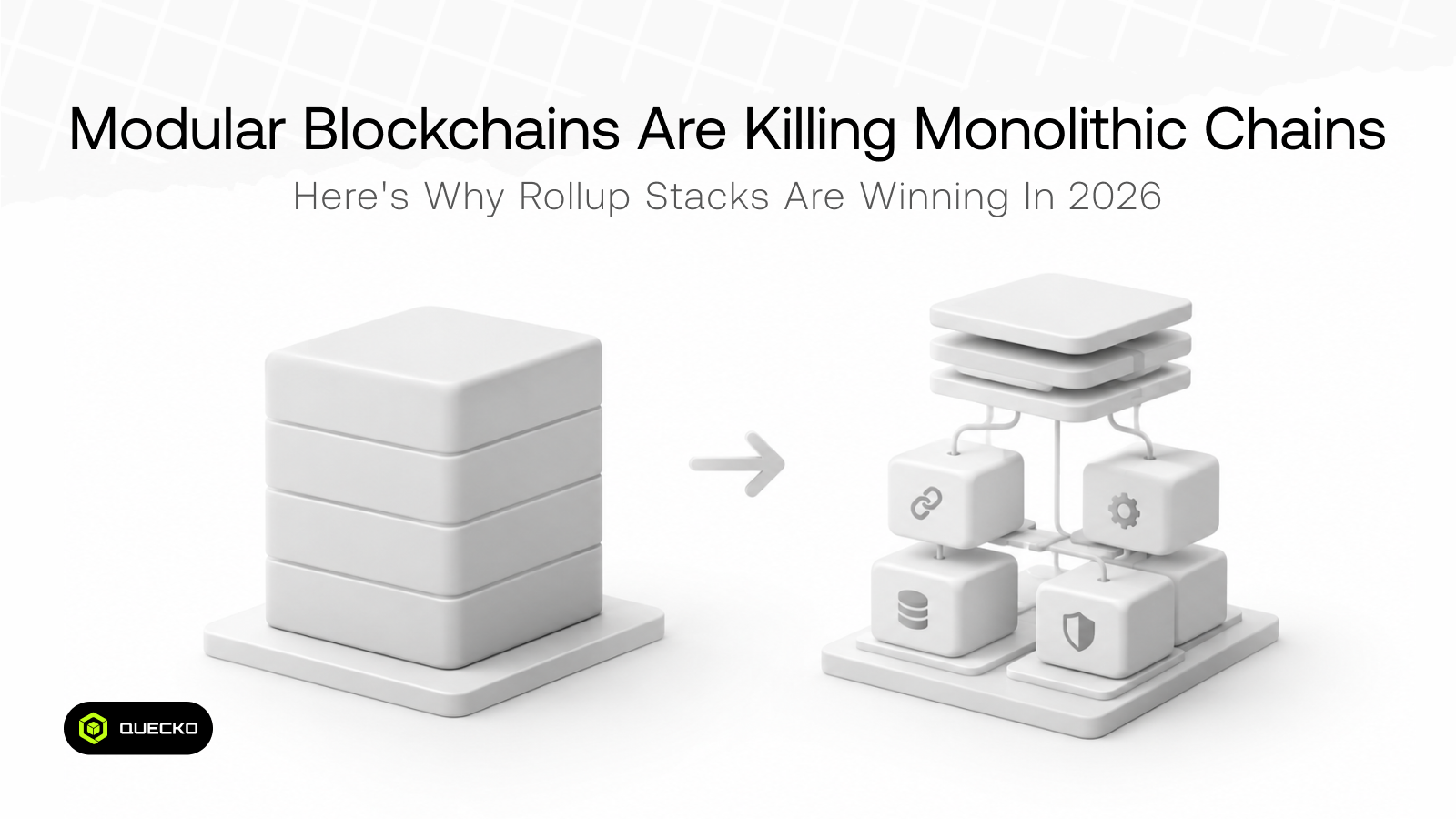
What is a modular blockchain? The definition of “modular blockchain” is the concept of a single blockchain not performing all tasks associated with a typical blockchain, including processing transactions, providing data accessibility, and settling transactions. Instead, these functions may be split into multiple specialized layers that work together to provide a complete solution. This topic was once discussed as an academic issue, but is now being considered as part of enterprise product strategy due to its implications for scalability.
Most blockchain solutions, especially in recent years, have gone by what can be called the “monolithic blockchain model.” It basically means you have only one network, one group of network nodes, and one blockchain space where your application competes for the same scarce resources as all the other applications. This architectural decision fits low-volume workloads perfectly.
However, as soon as demand for the chain increased, this model became unsustainable.
By 2026, the transition is no longer conceptual. Companies that build payment rails, tokenized asset platforms, loyalty systems, and consumer-facing financial product applications will choose a modular rollup stack as their preferred architecture; however, they will do so for economic reasons rather than as a fad. The maturation of purpose-built data availability networks, dedicated execution environments, and shared security infrastructure has provided product teams with the capability to deploy application-specific infrastructure on a startup budget, while simultaneously providing institutional-grade guarantees.
The Architectural Shift: Why Monolithic Chains Hit the Wall
Every monolithic chain eventually meets the same ceiling: one set of nodes is asked to execute transactions, store data, and settle disputes simultaneously, so the slowest job sets the pace for all of them. Add users and the queue lengthens. Add block space and the hardware requirements climb until only a handful of operators can keep up. By 2026, that trade-off is an architectural choice rather than a law of physics—and enterprises building for millions of users are choosing differently.
What is a modular blockchain, in business terms? The task of the ledger is divided into specialized layers, including execution, which is performed by rollups tailored to the needs of the application; data availability carried out by an exclusive DA network; and settlement anchored onto a chain with very strong security, which is modular blockchain in business terms.
The honest counterpoint: complexity has a price. A comparative study of blockchain architectures found the monolithic approach outperforms the modular architecture in transaction costs by 36.7%—the cost-of-complexity tax you pay at the starting line.
That tax is shrinking fast. Celestia Fibre demonstrated throughput of 1 terabit per second in testing, effectively removing the data bottleneck, while EigenLayer commands a 93.9% market share in the restaking ecosystem as of early 2026, and Avail DA provides 250 ms preconfirmations for modular chains. The economics have moved toward application-specific environments.
Decoupling for Performance: The Role of Data Availability (DA)
On a monolithic chain, posting data and executing logic compete for the same scarce block space. Your checkout flow bids against someone else’s token launch. Separating those jobs removes the auction entirely: the rollup executes, and a dedicated DA network guarantees the data behind those executions is published and retrievable.
Celestia Fibre demonstrated a throughput of 1 Terabit per second in testing, effectively removing the data bottleneck that defined earlier generations of infrastructure. Bandwidth, in other words, is no longer the constraint a product team designs around.
Avail DA provides 250ms preconfirmations for modular chains, enabling near-instant user feedback —a figure the Avail Project publishes for its DA layer. For a product owner, that figure is more important than raw output. The difference between an active button and a wheel that loses credibility lies in the definition of that figure.
The older generation of data storage uses common blockchain networks to evaluate the value of each byte with respect to how it can be used for settlement, which is why the pilot tests carried out by the companies at first had so few features. Modular DA reverses that calculus: data becomes cheap enough that rich transaction histories, on-chain state for complex interfaces, and high-frequency interactions stop being line items to defend in a budget review. Interfaces can finally behave like software instead of like infrastructure.
Rollup Stacks in 2026: Optimistic vs. ZK Frameworks
The recent discussions around optimistic rollups and ZK rollups have evolved into choosing what kind of rollup technology to buy, and that choice means a lot now, especially when it comes to the new architecture of modular blockchains, as the execution layer no longer represents limitations but has become a separate component to select.
Optimistic frameworks assume that everything works, while letting you make a challenge in case fraud happens, meaning that running more affordable systems becomes easier, because optimistic solutions usually closely resemble EVM enough for us to use the majority of existing contracts. The downside of this model is withdrawal delays, as funds have to stay pending to allow someone to challenge their legitimacy.
ZK frameworks prove correctness cryptographically before settlement. In the case of validity proofs, there is no need for a challenge window anymore, so it is now possible to achieve faster exits, but it still needs a lot of money to prove their legitimacy and create some specific tools.
Creating a dedicated chain now becomes just a simple configuration task instead of lengthy protocol creation work, where the only question we need to ask is which one to take.
Rollup-as-a-Service providers have collapsed the deployment effort for both. Launching a dedicated chain is now a matter of configuration rather than a process that takes a year to complete, which alters the essential question from whether we can to which one. Modular blockchain architecture presents answers at the layer level, where one can change the execution environment at no extra cost to settlement or data availability.
- Choose ZK for financial matters, custodianship, or any sector in which investment/profit should run out quickly, or where regulators might query how correctness was assured.
- Choose Optimistic for gaming, socializing, loyalty, and consumer products where transaction costs and speed of production are more important than speed of exit.
Solving the Fragmentation Problem: The Interoperability Layer
The greatest criticism of the modular blockchain design is also the fairest one, which states that one thousand chains for particular applications means one thousand completely separate liquidity sources, which is really hard for many users already facing difficulties understanding issues relating to bridging. Early modular deployments genuinely made this worse before they made it better.
These developments have changed the picture. Shared sequencers act as the connective tissue—a common ordering service across multiple rollups that can sequence transactions touching several chains in the same batch, which makes cross-chain operations atomic rather than hopeful. Intent-centric design shifts the burden from user to solver: instead of specifying which chain and which bridge, a user declares an outcome — swap this for that, settle this invoice — and a competitive network of solvers finds the route. The atomic bridge protocols ensure that either the whole transfer occurs or none of it occurs, removing the partially completed transfer that has caused numerous funnels to fail.
Protocol-level developments in the settlement layer, such as Fusaka’s contribution, reinforce the shared goal: affordable data, better alignment between layers, and a user-facing experience that merges the stack back into something that the user would see as just one layer rather than a whole bunch of layers.
The destination is infrastructure that nobody notices. When a customer completes a purchase without knowing which execution environment settled it, the fragmentation problem has been solved — not by consolidation, but by abstraction.
What Is a Modular Blockchain Security Model? The Restaking Revolution
Launching a sovereign chain used to require bootstrapping an entire validator set and the token economics to pay for it — a capital problem disguised as a technical one. A new network’s security budget starts at zero, which is precisely when it is most attractive to attack. Restaking removes that cold-start requirement by letting already-staked capital on an established chain be re-committed to secure additional services, with slashing conditions that make misbehavior expensive across both commitments at once.
Until early 2026, about 4.6 million ETH has undergone restaking with nearly 1,900 operators.
Security-as-a-Service means a modular chain rents cryptoeconomic guarantees from a shared pool. Security-as-a-Service means that a modular chain acquires the crypto-economic guarantees from the common pool, rather than creating them from scratch. Thus, product teams are able to build execution environments using startup budgets while still obtaining institutional-level security.
The trade is real: pooled security concentrates correlated risk, and a slashing event affecting the shared pool touches every service drawing from it. Native validator sets isolate that risk — at a cost most products cannot justify until scale arrives.
Building for the Modular Future with Quecko
Most teams evaluating rollup stacks in 2026 are not short on options — they are short on a framework for choosing. Quecko’s development teams use a backward problem-solving method: what does the business want to achieve? What should be the cost of the business process in order to have the economy of the business under control? Which environment will work for roadmap features that will be developed within a year? This evaluation happens prior to writing any contract line; otherwise, the budget will disappear while trying to restore the process.
Design carries equal weight. In an intent-centric world, the interface is where modularity either succeeds or fails. Users declare outcomes; the stack resolves them. Quecko’s product designers build flows where chain selection, bridging, and gas abstraction disappear behind the experience a customer expects from any well-made application — the standard mass adoption has always been measured against.
The architecture of a project is always important, be it a consumer product, tokenized asset platform, or a move away from infrastructure that has reached its limits.
Scale Your Modular Product — book a strategy session with Quecko to map the right stack for your next build.
Conclusion
Choosing a modular blockchain architecture is not merely an act of enhancing transaction speeds. It enables enterprises to customize their infrastructure flexibly when their products and user needs increase. Since running, data availability, and settlement are separate, teams are empowered to make changes only to specific parts that might need a change without reconstructing the whole system.
This method also simplifies controlling expenses through specific tools and joint security rather than starting to create everything from scratch. At the same time, improvements in intent-centric design are helping simplify the user experience by hiding the complexity of chains, bridges, and gas fees.
Ultimately, choosing the right rollup stack is both a technical and commercial decision. It affects the long-term expenses and performance of a product, and its safety and scaling possibilities. Companies making such decisions wisely will be well-prepared to build applications meeting future requirements.
FAQs
1. What is the difference between modular and monolithic blockchains?
Monolithic blockchains perform execution, data availability, and settlement on a single network. Modular blockchains achieve this by splitting the functions into specialized layers, which can then scale independently and thus overcome bottlenecks.
2. Why are enterprises choosing modular rollup stacks in 2026?
Modular rollup stacks offer better flexibility, scalability, and cost control. They allow businesses to build application-specific infrastructure without managing an entire validator network.
3. Is modular blockchain architecture more expensive to operate than a monolithic chain?
Initially, yes. Modular systems can have higher transaction costs due to added complexity. However, dedicated data availability networks and shared security can help reduce costs as applications grow.
4. How does restaking improve security for modular chains?
Restaking enables leveraging staked funds to secure extra blockchain services. It allows new modular blockchains to leverage the existing security without creating a separate validator network.
5. What is the main risk of modular blockchain architecture?
Fragmentation is a big problem, as dozens of independent chains lead to liquidity being kept in separate pools and the process of bridging becoming complicated.
6. When should a team choose ZK rollups over optimistic rollups?
ZK rollups work well for financial scenarios that require faster withdrawals and the presence of mathematical verification proofs. On the contrary, Optimistic rollups are better suited for gaming, social, and consumer applications as they offer less expensive and more adaptable features.
7. How does intent-centric design relate to modular infrastructure?
The intent-based model lets users specify their target, and there is no need for the user to choose chains and bridges. Then the solver takes over the necessary steps required in this process.
Author

Khola Abbasi
Blockchain & Crypto Marketing SpecialistA writer with a focus on DeFi and smart contracts. I simplify technical topics through clear, engaging content. Sharing ideas, insights, and what I'm learning.
Date
7 days agoShare on

Related Blogs

Beyond Endorsements: Why Equity-First Models Are Redefining the Player-Owned Economy
5 days ago
USDT vs USDC: Which Stablecoin Is Better for Enterprise Digital Infrastructure in 2026?
11 days ago

How Businesses Use Stablecoins for International Transfers
14 days ago