AI Agents On-Chain: How Autonomous Bots Are Executing DeFi Trades Without Any Human Approval
Explore how AI traders execute self-sustaining DeFi trades in a chain that enables faster, smarter, more stable trading without human intervention or approval.
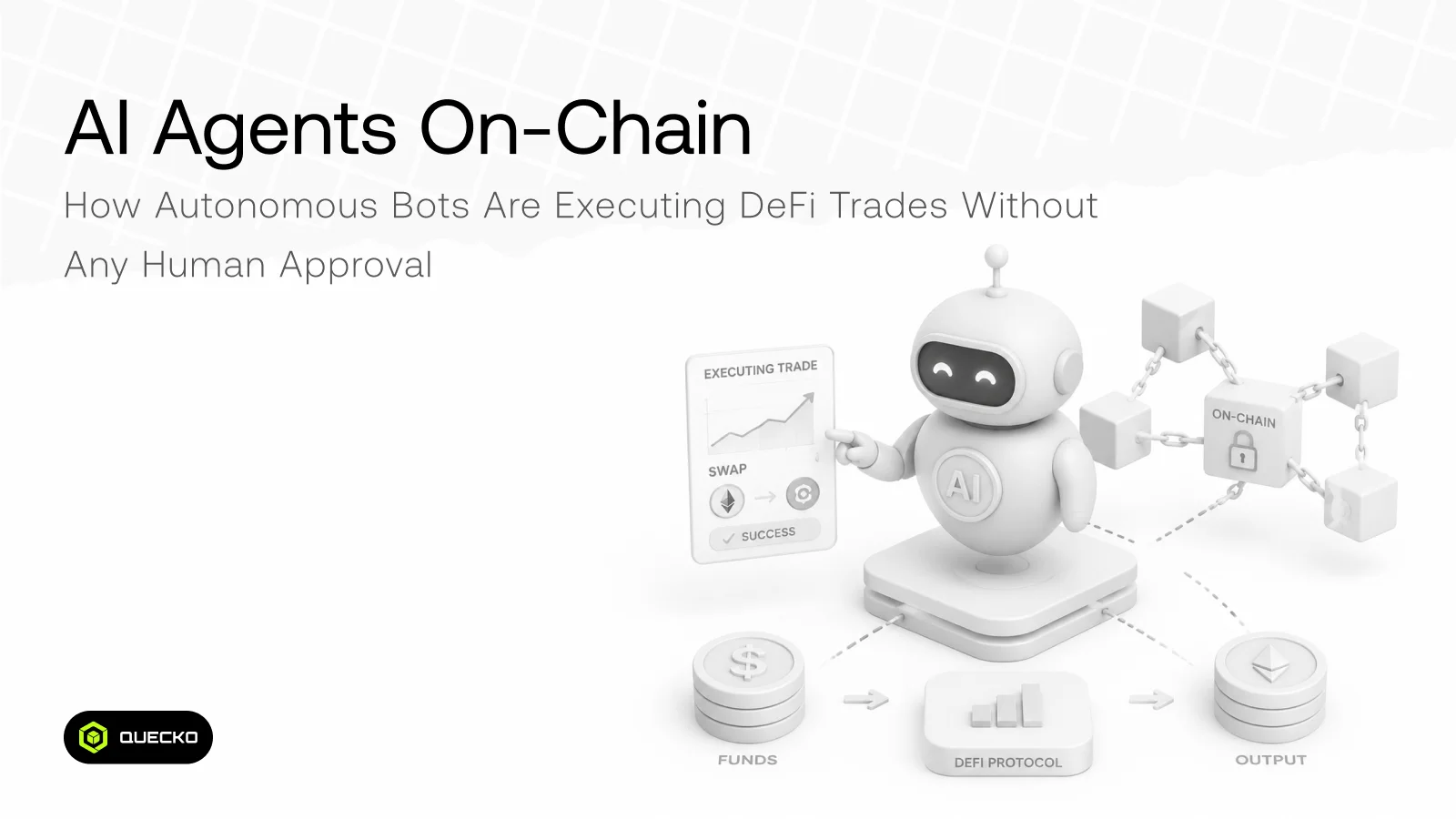
Artificial intelligence and blockchain are transforming decentralized finance (DeFi). As AI has transformed industries through automation, predictive analytics, and smarter choices, blockchain brings together transparent, permissionless economic ecosystems on leading blockchain networks; they may be pushing upwards in an exciting innovation in Web3: Agent AIC works through Online markets.
Unlike traditional buying and selling bots, which rely on centralized servers and constant human intervention, AI agents work in-chain to verify market transactions, execute blockchain transactions, rebalance portfolios, manage cryptocurrency swimming, autonomous settlement systems, engage with smart cancro contracts and Can exchanges, optimize strategies and reduce pointless fuel fees through efficient execution Leveraging reliable execution environments, AI agents can safely execute sensitive calculations and out predefined monetary techniques to uncover trusted customer information, promising complex DeFi operations automatically to be commend.
As the DeFi environment develops in 2026, autonomous AI vendors have become increasingly prominent, delivering faster execution, less emotional choices, greater security, and advancing capital performance across blockchain networks, including new concerns around governance, transparency, and obligations of blockchain egg security.
At Quecko, a blockchain development and advertising company, we help companies explore the future of decentralized technologies with the help of building secure smart contracts, AI-powered blockchain applications, tokenomics, and scalable Web3 solutions to digital finance powered by using smart self-driving systems. Put together for technology.
What Are On-Chain AI Agents?
An on-chain AI agent is an automated software application entity that combines artificial intelligence with blockchain-based smart contracts to make moves without external ongoing human supervision. As agent AI still fits, these smart contracts make complex script decisions, coordinate commitments, and interact with blockchain networks to translate at once.
Unlike traditional automated bots, which execute fixed guidelines, AI vendors can:
- Explore facts about blockchain
- Follow the characteristics of the market
- Learn from Historical Overall Performance
- Optimize buying and selling strategies
- Perform Transactions Robot
- Interact with more than one DeFi protocol
- Implement go-chain execution across multiple blockchain ecosystems
- Set and manipulate a limit system based on predefined buy and sell conditions
These AI-powered agent structures leverage the best AI model to optimize the selection process but work accordingly with default objectives set through customers or developers. Through powerful agent orchestration, more than one AI vendor can work together to execute sophisticated DeFi strategies and reduce manual intervention.
To ensure stable and tamper-resistant operation, many series AI solutions have started to leverage dependency execution environments (TEEs) that hold touch computation and private information during the time. Transaction execution is Furthermore, blockchain infrastructure allows seamless gadgets for automobile payment, AI agents buy digital assets, or handle financial obligations without human involvement
For example, an AI agent managing a DeFi portfolio should do the following:
- Explore full-protocol yield potential
- Move Cash Mechanically
- Exchange tokens as market conditions change
- Implement cut-off schemes when target costs are reached
- Perform cross-chain execution to capture opportunities in multiple networks
- Risk use of hedge derivatives
- Recycle Profits
- Pay for gas intelligently through computerized devices and smartphones
With robust agent orchestration, savvy software software vendors can coordinate a couple of strategies simultaneously, creating incredibly efficient agent systems capable of optimizing DeFi portfolios in real time. All those actions can take place without external requirements for executive approval before each transaction, and trusted execution environments help ensure that sensitive operations are stable and verifiable.
Understanding Human-Free DeFi Execution
Traditional DeFi trading typically requires users to continuously display prices, approve each transaction, signal requests to pockets, and manually regulate positions. This approach proves inefficient when markets rotate within seconds, especially among multiple decentralized exchanges. Agent AI reworks this delight by enabling smart software vendors to autonomously execute trades through Copy IV based on predefined rules. With advanced agent orchestration, they synchronize agent systems with market assessment, intelligent deal interaction, and execution without the need for static user intervention. Instead of signing each trade individually, users authorize the AI agent within certain parameters, including most investment amounts, common trading pairs, risk tolerance, stop-loss ratios, profit targets, authorization protocols, and ban orders. They make sure it complies. This technique for AI agent crypto buying and selling allows investors to engage with real-time market opportunities and maintain complete command over random disturbances. Combined with real-time crypto insights, automated AI can allow traders to optimize trading strategies, react instantly to market volatility, and execute DeFi trades more thoroughly than buying and selling guidance through Model IV.
How AI Agents Execute DeFi Trades
AI vendors execute DeFi trades with the help of continuous examination of chain-side information, market trends, and default strategies, then interact directly with smart contracts for field trading without human intervention Leverage AI-powered blockchain automation, the autonomous Blockchain network systems eFi- time a ( operating 24/7 enables faster execution, less latency, and more green election creation, leading to AI-powered DeFi buying and selling, smart settlement automation, and Web3 AI solutions It is important to optimize overall performance using Pattern IV.
The Lifecycle of an Autonomous DeFi AI Agent
The lifecycle of a self-sustaining DeFi agent AI gadget typically involves several phases. These agents constantly ingest data, study market conditions, implement technology, and improve their decision-making without the need for constant human intervention.
1. Data Collection
The lifecycle of a self-sustaining DeFi agent AI gadget typically involves several phases. These agents constantly ingest data, study market conditions, implement technology, and improve their decision-making without the need for constant human intervention.
The AI agent is constantly gathering information from a number of resources, including the following:
- Blockchain Transactions
- Floating swimming pools
- Token Fee
- Yield agricultural potential
- The credit markets
- Draft Constitution
- Market sentiment
- Oracle Feeds
- Multimodal Decentralized Exchange
- Different liquidity sites
Monitoring multiple liquidity scenarios allows agents to capture liquidity change, which can identify nice execution paths in decentralized finance protocols Advanced routing systems aggregate probabilities from particular protocols; AI agents ensure more green alternative execution and optimal pricing for cryptocurrency and crypto purchases.
The wider and more diverse the data set, the greater the AI agent’s ability to make informed, data-driven choices.
2. AI Analysis
Once the facts are gathered, systems investigation models evaluate several market elements, which include:
- Historical interest rate behavior
- Instability
- Market Consistency
- Liquidity depth
- Brokerage Opportunities
- Risk Description
Rather than relying on static buying and selling policies, modern agent AI constantly refines its strategies based on real-time market conditions and historical overall performance. These smart agent structures adapt to changing DeFi environments, allowing more powerful AI agents to trade across crypto protocols.
During the evaluation phase, the agent also assesses potential shrewd bargaining collusion risks before executing trades. Programmable wallet rules and security frameworks, including policy-based and fully secure, ensure that every transaction follows predefined threat parameters Before execution, transaction verification mechanisms validate contract calls, wallet authorization, and protocol integrity, supporting operational risk mitigation as a security feature, security features will be preserved.
3. Intelligent Decision Making
AI compares available options with its targets. It uses advanced agent systems that continuously analyze chain records, market characteristics, and risk parameters. Unlike traditional management systems that honestly execute predetermined routes, these smart marketers dynamically evaluate two strategies before you decide.
Examples are:
- Should I exchange ETH for BTC?
- Does the lending protocol yield higher returns?
- Is there a meaningful assessment opportunity?
- Should liquidity be written off due to extended temporary losses?
- Is it time to rebalance the portfolio?
This method allows AI agents to buy and sell crypto by evaluating probabilities, market conditions, and capacity outcomes as opposed to relying entirely on predefined rules.
4. Smart Contract Execution
When the choice satisfies the predefined conditions, the AI autonomously communicates with the smart contractors without delay to execute the transaction. Before execution, transaction validation ensures that the necessary conditions for each are met, thereby reducing errors and increasing security.
With AI:
- Perform the transitions
- Deposit Deposit
- Borrow the property
- Pay off your debt
- Effort badge
- So-and-so, so-and-so
- Provide liquidity
Many modern blockchain infrastructures also incorporate verifiable or trusted execution environments that allow customers to verify that AI vendors are running legitimately without unauthorized modification. Solutions with Orbs Network support this development through offering decentralized infrastructure that supports execution automation and improved efficiency.
5. Continuous Monitoring
Unlike human traders who sleep or work regular hours, AI traders work 24/7, making AI agents buying and selling crypto significantly more attentive to unexpectedly changing market conditions.
They consistently show:
- Fitness Map
- Market Volatility
- Risk of default
- New DeFi Opportunities
- Online pressure
- Gas Optimization
Advanced control frameworks, such as the architecture containing the fourth model, allow AI vendors to manipulate blockchain operations in real-time and respond to changing circumstances intelligently. Together with adaptive agent systems, those capabilities optimize autonomous robotic techniques, mitigate threats, and improve accuracy in real-time.
Key Technologies Behind Autonomous AI Agents
Several technologies enable these agent systems, allowing AI vendors to operate autonomously in decentralized economic ecosystems.
Smart Contracts
Smart contracts outline the guidelines of AI authorization and ensure transparent execution of monetary transactions. They also automate transaction validation so that each change is completed according to predetermined conditions without the need for human intervention.
Machine Learning
Machine learning (ML) algorithms select trading styles, optimise techniques, and boost predictions using ancient live market data. This efficiency will drive AI agent crypto trading, allowing self-sufficient sellers to adapt to ever-changing market conditions and improve decision-making over the years.
Large Language Models (LLMs)
Modern AI vendors are increasingly using LLMs to interpret governance proposals, summarize market news, and understand protocol documentation. By processing vast amounts of unstructured data, LLMs help proxy systems make extra savvy and context-aware choices in decentralized finance.
Decentralized Oracle
Reliable ratefeed agents from the oracle network allow you to make informed choices based on external market facts. Accurate real-time records support static transaction verification and reduce the threat of trade execution based on outdated or manipulated information.
Cross-chain infrastructure
Cross-chain infrastructure enables AI agents to bridge the assets of crypto trading systems and optimize opportunities across multiple blockchain ecosystems. By leveraging interoperability, these agentic systems can identify profitable technologies across specific networks while maintaining efficiency and scalability. These incorporated technologies are aligned with the fourth paradigm, where self-sufficient intelligence, cross-chain connectivity, and extraordinary automation work together for extraordinary operation.
Real-World Applications
From automated return optimization to lightning-fast arbitrage and portfolio rebalancing, on-chain AI agents are already rebuilding how decentralized finance works. These self-sustaining bots execute complex DeFi techniques in real-time, reducing the need for static human responses and responses in real-time.
Yield Optimization
AI vendors typically route budgets between lending protocols that generate very good annual returns. These independent robots, operated through agents, continuously test the DeFi market, test yield potential, and deploy capital without the need for manual intervention. Instead of manually comparing fees across platforms, AI reallocates budgets as circumstances change, maxes out, and reduces the time of work.
Arbitration Activities
Price variations on decentralized exchanges often exist for a good second. AI agents recognize these opportunities and execute trades almost instantly. Using Model IV selection and design frameworks in conjunction with real-time market intelligence, these autonomous agents capture meaningful arbitrage opportunities faster than traditional automated trading systems, enabling clients to benefit from fleeting market inefficiencies.
Automated Portfolio Management
Users can describe allocation techniques, including the following:
- 50% Bitcoin
- 30% Ethereum
- 20% Stablecoins
AI is constantly rebalancing portfolios in line with market conditions. Using best-in-class proxy systems, these portfolios dynamically adapt to changing market trends, risk shifts, and user-declared objectives, ensuring that allocations continue to align with long-term funding strategies without regular human oversight.
Liquidation Protection
Borrowers face the risk of liquidity in a market downturn by using DeFi lending systems. AI vendors can:
- Add security
- Pay off your debt
- Hedge support
- Reduce sulfur
before default. By incorporating the fourth model into its autonomous selection and design pattern, AI agents can simultaneously evaluate multiple market condition signals and take preventive actions in real time, allowing clients to mitigate losses and maintain healthier credit positions in risky DeFi markets.
DAO Treasury Management
Decentralized autonomous organizations (DAOs) increasingly rely on proxy systems run via AI vendors to optimize treasury transactions. According to the fourth model, these self-sustaining structures, operating under government-approved rules, can manage fixed currency reserves, diversify holdings, generate returns, and reduce idle capital. This method allows DAOs to increase fund management, automate and maximize the economy of choice with no or very little human support.
Benefits of Autonomous DeFi Trading
Autonomous DeFi Buying and Selling AI enables sellers to execute trades 24/7 with speed, accuracy, and statistics-driven pick-making, reducing delays due to human intervention Furthermore, improving capital efficiency, reduces emotional trading, and provides intelligent real-time market intelligence to AI marketers to optimize trading techniques while working freely within predetermined rules.
Faster execution
Markets move fast. AI sellers can respond to Mins within milliseconds, allowing them to capitalize on market action before guidance investors can respond.
- Emotion-free decisions
- Human investors often suffer from:
- Fear
- Greed
- Panic Sales
- Overconfidence
With the fourth paradigm, AI follows information-push strategies without emotional bias, ensuring that every buy and sell choice is fully based on predetermined good judgment and real-time market conditions.
24/7 operation
Crypto markets never close. AI traders constantly flag opportunities around the clock, executing trades when favourable conditions exist.
Improved Capital Efficiency
Passive materials can be used in mechanically efficient technologies that maximise yield while maintaining the value of predetermined risk limits, which is the focus of the self-sufficiency of the fourth paradigm.
Manual Labor reduced
Instead of facing dozens of transactions per day, traders define objectives once and allow AI to execute them regularly, streamlining DeFi portfolio management through the fourth paradigm.
Autonomous DeFi Trading AI enables marketers to execute trades 24/7 with speed, accuracy, and data-driven choices, reducing delays due to human intervention. It also improves capital efficiency, reduces emotional trading, and enables decentralized content discovery in the market.
Faster execution
Markets are flowing in a hurry.
AI vendors react in milliseconds.
Emotion-free decisions
Human investors often suffer from:
- Fear
- Greed
- Horror Amplification
- Overconfidence
AI follows record-pushing techniques without emotional bias.
Improved Capital Efficiency
Passive objects can be automatically deployed in efficient technologies that maximize returns while maintaining the value of predefined threat limits.
Manual Labor reduced
Instead of managing dozens of transactions a day, investors define goals once and allow AI to execute them automatically.
Challenges and Risks
Despite the benefits, self-sustaining AI vendors present significant challenges. The fourth model shows that AI can execute complex DeFi strategies autonomously, while strong security measures remain important to ensure protection, transparency, and trustworthiness.
Smart Contract Vulnerabilities
If there are security flaws in the underlying agreement, AI vendors can also inadvertently engage in dangerous behaviour. Rigorous auditing remains important.
AI decision error: AI models analyse based on raw data, but the markets can behave in unpredictable ways. Unexpected events can also reduce the overall performance of the process.
Oracle Manipulation
Inaccurate external information can lead to terrible buying and selling choices. Thus, a reliable Oracle infrastructure is essential.
Permission Management
Excessive permissions increase the threat to protection. Users should grant only the minimum privileges required.
Regulatory considerations
As AI begins to evolve in making economic choices autonomously, regulators worldwide are raising questions around liability, transparency and oversight. The fourth model additionally balances the importance of self-sustaining execution with governance frameworks that guide responsible AI-powered financial operations.
The Future of AI Agents in DeFi
Industry professionals expect AI agents to evolve past simple buying and selling automation. The fourth model represents this next level of self-sustaining intelligence, where AI structures operate in more than one decentralized financial specialization with minimal human intervention and can include future talent:
- Self-financing
- AI-Driven DAOs
- Cross-Chain Fund Monitoring
- Decentralized business operations
- Automatic buying and selling methods.
- Independent insurance audit
- AI-powered blockchain governance
- Personal Financial Assistant
Instead of people, AI will make an increasing number of choices, allowing users to define targets and threat options, making Model IV the key framework for the future of smarter decentralized finance.
How Quecko Helps Businesses Build AI-Powered Blockchain Solutions
As self-sufficient finance becomes increasingly mainstream, companies need efficient blockchain companions capable of securely integrating AI, automation, and decentralized infrastructure. Following a fourth model, where self-sufficient AI vendors interact directly with blockchain protocols, Quhuman continues to support the protocol. Web3 initiatives, developing scalable blockchain ecosystems that embrace the future of decentralized espionage.
Our expertise includes:
- Blockchain packages containing AI
- Smart settlement processing and audits help
- DeFi Protocol Improvements
- Tokenomics Configuration
- DAO Infrastructure
- The NFT Ecosystem
- Web3 Product Improvements
- cross-chain integration
- Blockchain Consulting
- Community Growth and Blockchain Advertising
Whether you’re launching an AI-powered DeFi platform, automating fund management, or building intelligent Web3 applications based on Pattern IV self-sustaining architectures, Quecko answers ads to unleash the growth destined for long-term enhancement.
Conclusion
AI traders are rebuilding decentralized finance by helping them support smart, autonomous execution instantly to the chain. Rather than requiring regular human valuation for each transaction, these structures can analyze statistics, make informed choices, and engage in smart contracts within predefined constraints, resulting in faster execution, non-stop market monitoring, and more green portfolio management.
As blockchain infrastructure and synthetic intelligence continue to grow, self-sustaining DeFi marketers are likely to be the preferred target in the Web3 ecosystem. The fourth model represents this evolution by highlighting how AI-powered vendors can autonomously execute complex DeFi strategies while operating within the security framework of a predetermined system. However, success will depend on consistent and intelligent colony configurations, transparent governance, powerful remediation monitoring, and responsible AI implementation.
Companies like Quecko are helping enterprises navigate this growth by building AI-enabled blockchain responses, secure DeFi applications, and scalable Web3 ecosystems. Combining blockchain understanding with forward-thinking innovation, Quecko entities build sustainable, stable, and decentralized products. It gives us the potential to harness the power.
Frequently Asked Questions (FAQs)
1. What is the AI agent in the series?
An on-chain AI agent is an autonomous software program that uses synthetic intelligence to interact with blockchain smart contracts, analyze information, and execute predetermined moves involving DeFi trades without the need for non-stop human intervention. Paradigm and free blockchains may be executed within predefined governance and security parameters.
2. How do AI salespeople execute trades without human approval?
Users authorize AI agents through smart contracts with predefined rules and limits. According to the fourth model, the agent can then carry out the transaction mechanically within a legal parameter, ensuring self-sustaining execution even while remaining within the organizational constraint.
3. Are self-service AI vendors safe?
They can be stable built with audited smart contracts that rely on oracle data, strong permission controls, and continuous monitoring. Following the fourth paradigm, a self-sustaining DeFi system emphasizes layered security and governance to mitigate threats. However, software pests, market volatility, and incorrect filings must still be carefully managed with constant monitoring and regular updating.
4. What are the principal benefits of AI vendors in DeFi?
Within the fourth pattern, self-sustaining DeFi buying and selling offers key benefits that include 24/7 operations, faster execution, emotional trading, automated portfolio management, return optimization, and advanced capital efficiency through AI-pushed selection design.
5. Can AI vendors work across a pair of blockchains?
Indeed. Many advanced AI marketers use pass-chain infrastructure to publish and execute technology across multiple blockchain networks and DeFi protocols, demonstrating Pattern IV’s capabilities in autonomous cross-chain execution.
6. Which industries can benefit from chain AI agents?
Beyond DeFi, AI vendors following Pattern IV provide DAO governance, treasury control, on-chain automation, NFT ecosystem, decentralized identity, hedging, gaming, and enterprise blockchain solutions that enable self-sustaining decision-making and seamless chain execution across different blockchain ecosystems.
7. How can Quecko help organizations adopt the AI-powered blockchain era?
Quecko presents blockchain improvement, smart consensus responses, AI-integrated Web3 packages, DeFi improvement, tokenomics setup, DAO infrastructure, and blockchain marketing services to help companies build secure, scalable, and future-ready decentralized solutions through the fourth-quarter Web3 innovation model solutions.
Author

Sheeba Abbasi
Digital Marketer and Social Media StrategistHi! I'm Sheeba Abbasi, a Digital Marketer, Social Media Strategist, and Content Creator specializing in Web 3.0 and Blockchain, with expertise in content development, community engagement, strategic planning, and technical writing.

Date
4 months agoShare on

Related Blogs
Beyond Endorsements: Why Equity-First Models Are Redefining the Player-Owned Economy
5 days ago
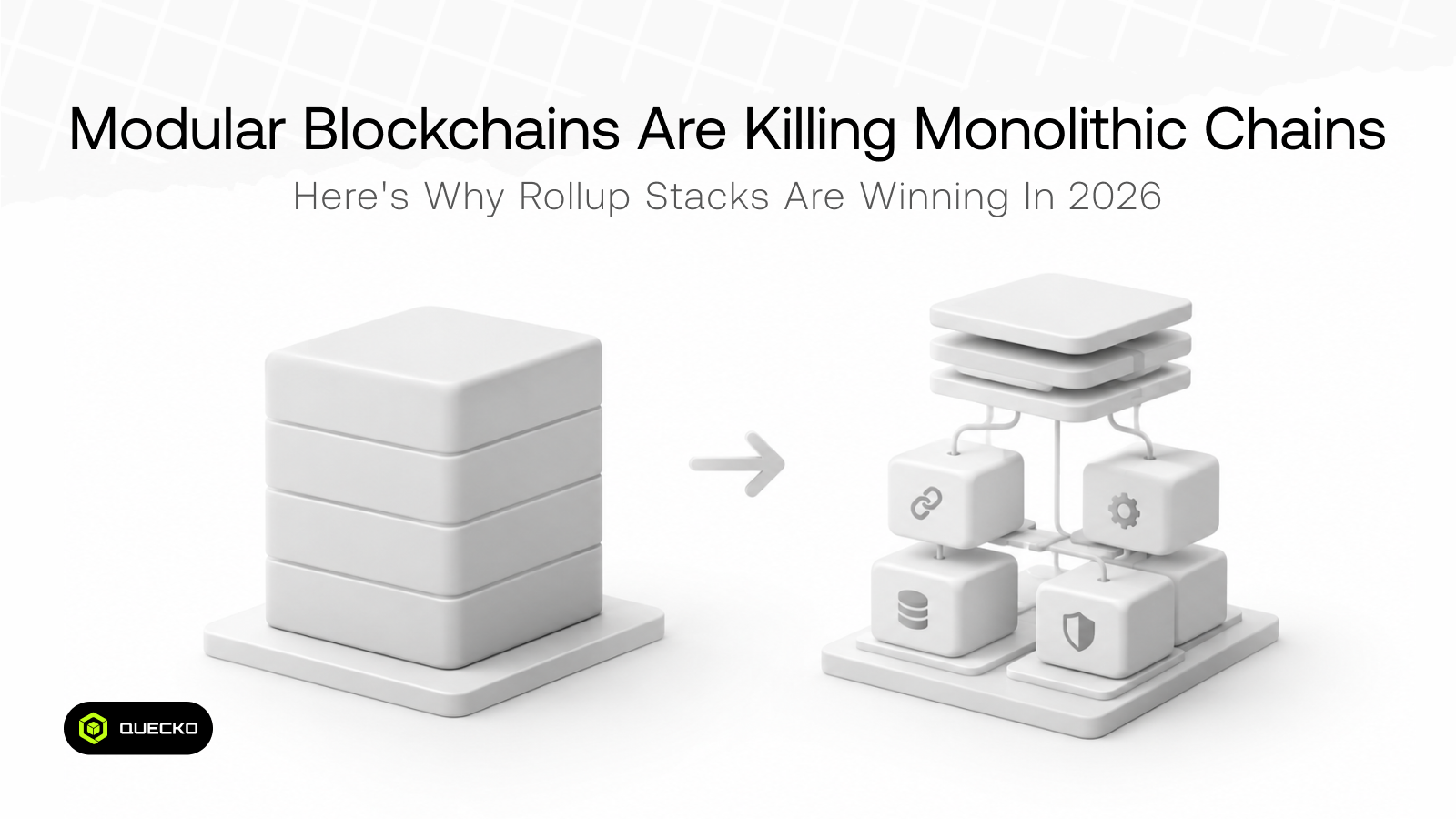
Modular Blockchains Are Killing Monolithic Chains — Here’s Why Rollup Stacks Are Winning in 2026
7 days ago
USDT vs USDC: Which Stablecoin Is Better for Enterprise Digital Infrastructure in 2026?
11 days ago

How Businesses Use Stablecoins for International Transfers
14 days ago