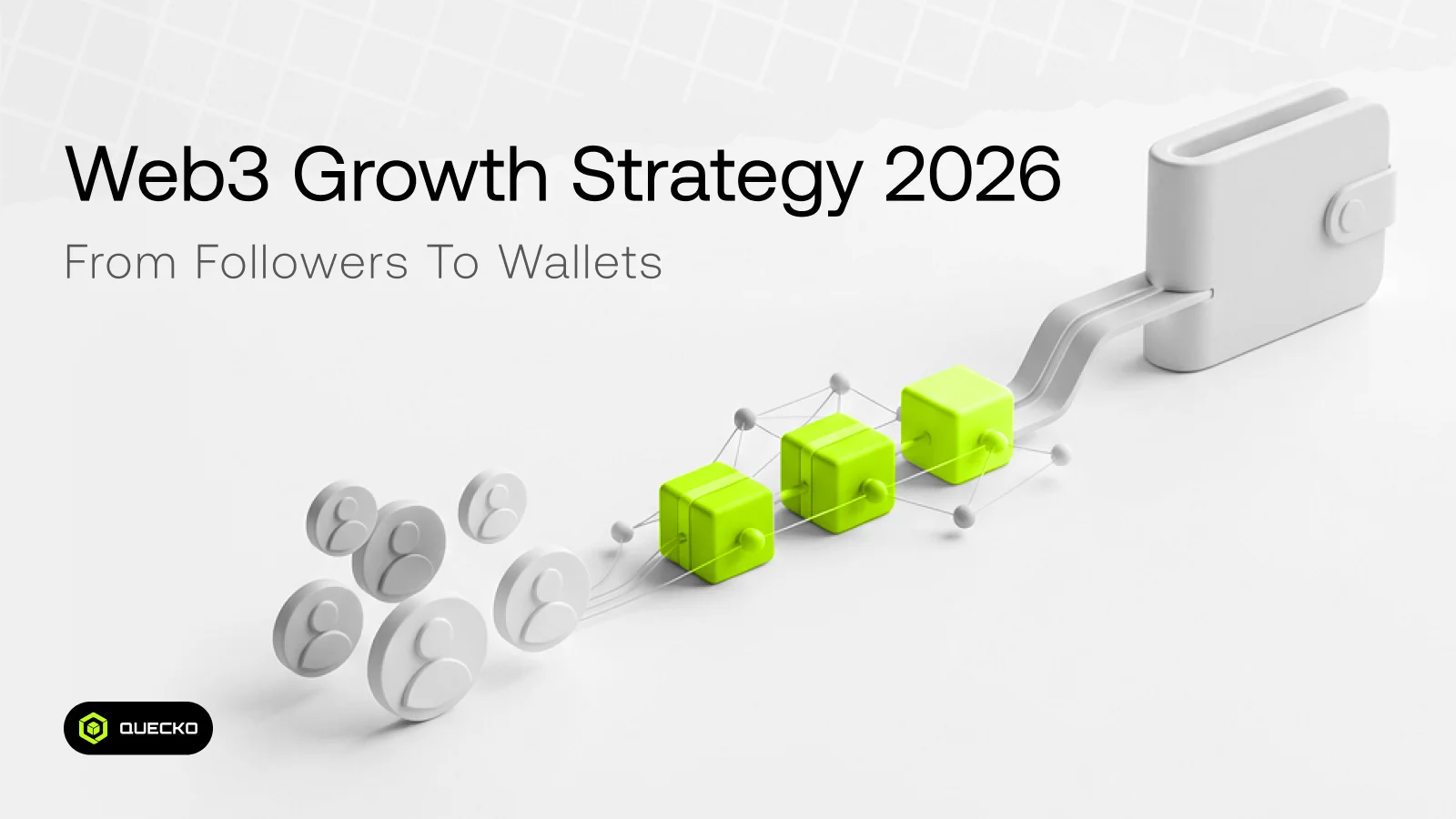
Web3 Growth Strategy 2026: From Followers to Wallets
Followers don’t pay the bills, wallets do. Learn the 2026 Web3 growth playbook: from X audience to community, wallet connection, usage and retention.
For years, Web3 marketing ran on a simple scoreboard: followers. Big X (Twitter) numbers signaled momentum, attracted investors, and made a project look alive.
In 2026, that scoreboard is broken.
Bot farms, engagement pods, and airdrop hunters have made follower counts one of the least trustworthy metrics in crypto. Users are more skeptical, and so are investors. The question that matters now is: how many real people connect a wallet, use your product, and come back?
This guide breaks down a modern Web3 growth strategy built around that question.
The Old Playbook Is Dead
The classic Web3 launch looked like this:
- Build hype on X
- Run a giveaway or whitelist campaign
- Launch a token or NFT
- Watch attention disappear within weeks
It fails for three reasons:
- Mercenary users. People farm your campaign, collect rewards, and leave.
- Vanity metrics. Followers and impressions say nothing about product-market fit.
- No retention loop. Nothing gives users a reason to stay after the incentive ends.
The new playbook treats growth as a funnel with five stages, and measures every stage with on-chain and product data, not social vanity numbers.
The 2026 Web3 Growth Funnel
Followers → Community → Wallet Connection → Product Usage → Retention
Let’s go through each stage.
Stage 1: Followers (Attention, Not Success)
X is still the main discovery channel for Web3, but its role has changed. Followers are the top of the funnel, not the goal.
What to do:
- Post content that educates or shows the product in action, not just price talk and “gm” posts.
- Use founder-led content. Audiences trust people more than logos.
- Build in public: share roadmaps, metrics, mistakes, and lessons.
- Collaborate with creators whose audiences actually use the product category.
What to measure: Don’t stop at follower growth. Track click-through rate to your site or community, which tells you whether attention is turning into intent.
Stage 2: Community (Where Trust Gets Built)
Followers watch you. Community members talk to you and to each other. That shift is where loyalty starts.
What to do:
- Move engaged followers into Discord, Telegram, or a dedicated forum.
- Create clear roles, ambassador programs, and contribution paths.
- Reward participation quality, such as feedback, bug reports, and content, rather than just activity volume.
- Host regular AMAs, product demos, and community calls.
What to measure: Active members per week, retention of community members, and the ratio of discussion to announcements. A quiet server with 50,000 members is a warning sign, not an achievement.
Stage 3: Wallet Connection (The Real Conversion Event)
This is the Web3 equivalent of a signup, and where most brands lose people. Connecting a wallet requires trust, and users are rightly cautious after years of scams and drainers.
How to increase wallet connection rates:
- Explain before you ask. Tell users why a connection is needed and what you will and won’t do with it.
- Offer a read-only preview. Let people explore the product before connecting.
- Support more wallets, including embedded wallets and social login options, to cut friction for newcomers.
- Never request unnecessary permissions. Make signature requests clear and human-readable.
- Show security signals: audits, verified links, and transparent team information.
What to measure: Visit-to-connect conversion rate, wallet types used, and drop-off at the signature step.
Stage 4: Product Usage (Activation)
A connected wallet is not a customer. Users are “activated” only when they complete a meaningful action, such as a first swap, mint, stake, vote, or game session.
What to do:
- Define your activation event clearly and design onboarding around reaching it fast.
- Cut steps. Every extra transaction approval costs you users.
- Use guided quests, but tie rewards to real product usage, not social tasks like retweets.
- Subsidize or abstract gas fees for first-time actions where possible.
What to measure: Time to first action, activation rate (connected wallets that complete the key action), and transaction completion rate.
Stage 5: Retention (Where Brands Are Won)
Acquisition without retention is expensive noise. The strongest Web3 brands in 2026 grow because users return, not because they pay for constant new attention.
What to do:
- Reward loyalty over one-time activity. Tiered benefits, reputation systems, and long-term holder perks work better than one-off airdrops.
- Use on-chain data to segment users. Treat a power user differently from a first-timer, with relevant messages and offers.
- Ship consistently. Frequent product updates give people reasons to come back.
- Give ownership. Governance rights and community input make users feel like stakeholders.
What to measure: 7-day, 30-day, and 90-day wallet retention, repeat transaction rate, and lifetime value per wallet.
The Metrics That Matter in 2026
| Old Vanity Metric | New Growth Metric |
| X followers | Click-through rate to product |
| Discord member count | Weekly active community members |
| Whitelist sign-ups | Wallet connection rate |
| Total transactions | Activation and repeat-usage rate |
| Token holders | 30/90-day retained wallets |
If your dashboard still leads with followers and impressions, rebuild it around the right-hand column.
Common Mistakes to Avoid
- Paying for fake engagement. It inflates numbers and poisons your data.
- Over-incentivizing. Heavy rewards attract farmers, not fans.
- Ignoring onboarding. The best marketing can’t fix a confusing first experience.
- Treating all wallets equally. A wallet with real history is worth far more than a fresh one created for a campaign.
- Going silent after launch. Retention needs continuous communication and updates.
A Simple 90-Day Action Plan
Days 1-30: Fix the foundation
Audit your funnel. Identify your activation event. Set up wallet-level analytics.
Days 31-60: Optimize conversion
Improve wallet connection flow, simplify onboarding, and replace social-task campaigns with usage-based quests.
Days 61-90: Build retention loops
Launch loyalty tiers, segment users by on-chain behavior, and establish a regular product and community update rhythm.
Final Thoughts
The brands that win in Web3 in 2026 won’t be the loudest. They’ll be the ones that turn attention into trust, trust into wallet connections, and connections into habits.
Followers get you noticed, but wallets, and the people behind them who keep coming back, build the business.
Ready to rebuild your funnel? Start by auditing one thing: how many of your followers have actually connected a wallet. That number tells you where to focus first.
FAQs
What is a Web3 growth strategy?
It’s a plan for acquiring, activating, and retaining users of a blockchain-based product, using on-chain data and community engagement instead of traditional vanity metrics.
Why are followers a poor metric for Web3 brands?
Follower counts are easy to inflate with bots and incentive farming, and they don’t show whether anyone uses your product.
How do you increase wallet connection rates?
Explain why you need the connection, offer read-only previews, support multiple wallet options, request minimal permissions, and show clear security signals.
What is a good Web3 retention metric?
Track 7-day, 30-day, and 90-day wallet retention along with repeat transaction rate.
Author

Areej Maqbool
Blockchain Writer & Web3 ExpertBlockchain Writer & Web3 Expert with 5+ years of experience creating high-impact content for crypto, DeFi, AI, and Web3 brands.

Date
2 months agoShare on