How Web3 UX Is Evolving in 2026: Making Blockchain Simpler for Everyone
Until now, Web3 products assumed that users had to adapt to their way of doing things. Seed phrases, gas, manual bridges, multi-stage approval processes, etc. – none of these were considered defects. Finally, assumptions about Web3 are changing, and Web3 UX trends for 2026 clearly illustrate this: the products succeeding in enterprise adoption are those […]
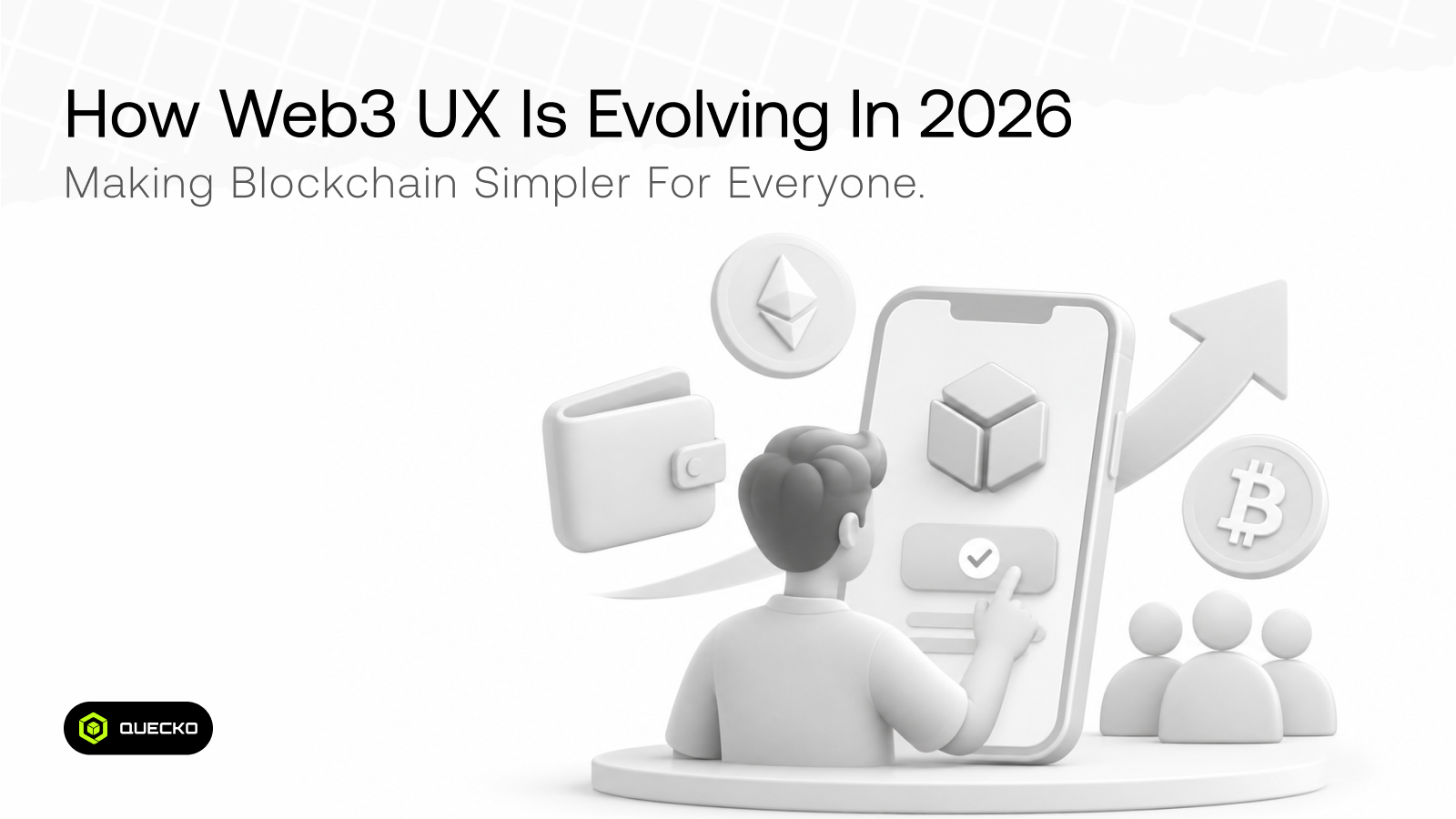
Until now, Web3 products assumed that users had to adapt to their way of doing things. Seed phrases, gas, manual bridges, multi-stage approval processes, etc. – none of these were considered defects. Finally, assumptions about Web3 are changing, and Web3 UX trends for 2026 clearly illustrate this: the products succeeding in enterprise adoption are those that make blockchain effectively transparent to users.
Fundamentally, the Web3 paradigm is shifting. It was initially intended to cater to early adopters, but now it is becoming a mainstream platform where the old assumptions will not hold.
Early adopters accepted the friction mainly because of their ideology-driven motivation to adopt the tech. But the new target user base of Web3-operational staff, regular buyers, loyalty program members, procurement officers, etc, only wants to get their job done. They will go straight to the product that does the job without asking, “What’s going on?” The following are the design & product decisions that will make such an outcome possible: intent-based UIs that simplify a multi-stage transaction into a single action, social logins that, on average, have cut the drop-off rate during the onboarding process by 30%, provenance systems that transform traceability of a product’s origin into a point of sale, and personalized experiences based on different roles, which read on-chain data without utilizing third-party trackers.
Web3 UX Trends 2026: The End of the Crypto-Native Era and the Rise of Invisible Infrastructure
The Web3 paradigm is changing completely from something that was designed for early adopters to a mainstream platform, for which the same assumptions do not apply.
“Web3 needs to go into the background to get the next wave of users.” – Gary Drenik, Forbes.
This concept of Web3 UX trends 2026 is driven by a very simple principle: the user. It is not so much that users adopt wallets based on their custodial requirements that users get on board. Their main reason, in fact, is the superiority of the tool in question over their present one. According to Forbes, one of the main drivers of adoption is the perception of a tool being better than what one currently has. 44% of the respondents mentioned that as their main reason. 24% are driven by the compatibility of the tool with their daily routines, a further indication that it is fit not ideas that bring people.
Excellent evidence of such a change in design thinking is intent-based design. Rather than getting the user’s permission through a long list of technical aspects, it simply asks for the goal the user is trying to achieve and does the routing, payment processing, and even ordering of the transactions in the background.
The system has stopped giving lessons about the inner workings of blockchain and is now providing users with a result, something that everyday people have begun to look for in a high-quality digital product.
Gartner identifies Digital Provenance as a top 10 strategic generation trend for 2026, and the worldwide Web3 marketplace is projected to attain $12.61 billion in 2026. MetaMask’s Social Login feature has reduced the amount of time it takes for new users to complete their registration process (onboarding) by approximately 30 percent. If you think about blockchain as a way to improve the “backend” of a system rather than disrupt the “frontend,” you will be on the right track.
From Technical Steps to Intent-Based Actions
Intent-based design completely changes our relationship with systems. Instead of having to tell a system every single step of an action (i.e., convert this balance into that asset; settle this invoice; move these credentials to a device), simply provide its intentions. A network of solvers then works together to determine how to accomplish those intentions. The system determines the fastest way to get from point A to point B, determines which chain to use to route through various liquidity providers, and ensures that each transaction is completed in the proper sequence — all while providing the user no visibility into or control over any part of the process.
The difference in what the interface demands is stark:
- Legacy model: select source chain, select destination chain, approve token spend, confirm bridge, wait for finality, acquire gas on the destination chain, approve swap, confirm swap.
- Intent model: state the preferred quit state, review a single preview of the result, verify as soon as possible.
The cost of organizational products is less related to the aesthetic of the product and more related to the potential for errors. The error rate increases each time there is a manual approval, as this creates another opportunity for the end-user (who has no technical knowledge) to select the incorrect network, fund a price inadequately, or completely abandon the process. When 8 decisions are reduced to 1, most of the area that causes support tickets to be generated — and therefore most of the area that causes the process to fail — will now be understood by Finance or Operations Teams who don’t need to know what a nonce is. This marks the transition from blockchain technology as an idea to blockchain technology as a functioning system. Organizations that were hesitant to adopt new technologies were often hesitant to adopt new technologies due to the complexity of the user interface for non-technical users.
Now they are in a position where they can proceed and make blockchain work for them. If the intent-based architecture is the case, then the purchasing team will be able to complete an invoice settlement on-chain with the same mental effort as simply approving a basic wire transfer. Essentially, what blockchain is doing is taking care of the hard work, and all the user sees is the outcome they desire. It’s this type of blockchain digital transformation that the enterprise decision-makers will really be interested in investing in.
Solving the Onboarding Crisis with Social Logins
The seed phrase has been the biggest barrier to using Web3. The seed phrase is the only password users need, and they lose everything in one go if it is lost. The user must make a long-term commitment to the product before they begin to realize any value from it, and there is also a risk of losing all of their data. No matter how much you revise or rewrite your copywriting, it will not help to solve this problem. Account Abstraction and Social Logins enabled the user to log in using an IDP (Identity Provider) that they are familiar with, while the smart contract account handled their keys.
MetaMask’s Social Login feature reduced onboarding friction approximately by 30%.
As a founder, you may find that the number of users dropping off right before they create their wallet is an immediate indication of your funnel math. Because many of the users who were dropping off right before creating their wallet are now getting to the point in which your product makes sense to them, this should lead to a very large increase in conversion rate.
In a B2C setting, loyalty programs, ticketing & resale, e-commerce ownership history: that difference defines if decentralization brings a feature or a problem.
Possibly one of the most popular features is social login. Nonetheless, it simultaneously requires dependence on an identity provider and a key-management service.
Nevertheless, the worst case is when both are dependent on the same service; however, the best scenario is when they are different services, and the users are able to choose the one they like the most. Most of corporate products should accept that option since it makes sense to let customers to do self-custody themselves if they don’t mind so while on the other hand give them the opportunity of being able to use even better self-custody if they do privacy/autonomy etc.
How Digital Provenance Helps Build Customer Trust
Provenance is where blockchain stops being an alternative payment rail and starts being an answer to a problem enterprises already have. Gartner has included Digital Provenance amongst the top 10 strategic technology trends for 2026. The reason for that is that, in a market where there is a high degree of synthetic media, duplicated listings, and supply chains that are not transparent. Having verified product origins can help businesses attract buyers, rather than serving only as a way to meet compliance rules.
The UX challenge is restraint. A provenance record is a dense object; a user needs a conclusion, not a ledger. Well-built interfaces floor an untried, untested nation and permit the chain of custody to expand most effectively on request:
- Product authenticity: a verified badge on a listing, with manufacturer, batch, and custody history available one tap deeper.
- Content origin: a writer attribution marker that distinguishes particular work from by-product or machine-generated copies.
- Supply chain assurance: a sourcing claim an enterprise can prove to a regulator and a consumer with the same record.
This is a very strong argument for a company to undergo a digital transformation based on using blockchain technology. This also provides support for the demand for “curves” behind an international Web3 marketplace that will be worth $12.61 billion by 2026. Trust, expressed as one aspect of the user interface, becomes a product feature.
Role-Aware Interfaces: Personalization Without Cookies
A connected wallet is an assertion of context, and interfaces are increasingly reconfiguring around what that context implies.
The governance participant. A wallet that holds a protocol governance token indicates a distinctive set of needs than a first‑time visitor. The interface can start by showing proposals, delegation status, and voting deadlines and hide the acquisition flows that the participant finished many months ago.
The liquidity provider. When a wallet has on‑chain position history, the interface should first show yield summaries, impermanent loss exposure, and rebalancing prompts. The same product shown to a wallet that has no positions should instead explain what a position is.
The loyalty member. Consumer programs are splitting concerns into a two‑token structure: one asset that has tradable value and one non‑transferable credential that records status, tenure, or membership tier. The interface reads the credential to decide what to show and reads the asset to decide what to offer, preserving tier integrity while keeping rewards liquid.
Digital provenance 2026 adds another layer to this personalization model. A wallet’s verifiable history. What the wallet has held, minted, or attested to. Can guide interface decisions without using inferred data. A user whose wallet carries a creator credential sees a different default view than a user whose history is only transactional. The provenance record does the work that a third‑party tracker would normally approximate, and it does this using the wallet’s own on‑chain state as the source of truth.
The privacy argument follows naturally. Personalization driven by means of a user’s personal on-chain context requires no cross-web page identifier, no behavioral profile the consumer by no means agreed to construct, and no cookie consent banner. The wallets speak for themselves — and the interface listens.
Key Takeaways for Product Leaders in 2026
The through-line for anyone evaluating enterprise Web3 adoption is that the technology has stopped being the product. Four decisions follow from that.
- Make the chain invisible by default. Users retain products that solve a problem, not products that explain their architecture. Ship the outcome; keep the protocol in the backend where HTTPS lives.
- Replace seed-phrase onboarding with social login and account abstraction. This is the single highest-leverage conversion fix available, and it recovers a meaningful share of the users who abandon traditional wallet setup before reaching any value.
- Design for intent, not transactions. Let clients declare very last results and permit solvers to handle routing, charges, and sequencing. Fewer preference factors imply fewer mistakes, fewer manual tickets, and a glide a non-technical purchaser can actually complete.
- Treat digital provenance as a differentiator, not a compliance line item. As a way to differentiate yourself from others in your industry, do not treat digital provenance as just another compliance issue. Rather, use digital provenance as a way to differentiate yourself from competitors. Virtual provenance is more than a compliance issue; it provides a competitive advantage. Do not treat digital provenance as merely a compliance issue. Instead, use digital provenance to show customers what makes your product or service different and why they should choose you. Competitors using traditional database systems will find it difficult to provide proof that products were created at the beginning of the process (of the product, file, or content) and therefore can never make this claim.
All three of these are decisions that should be made before the technical aspects are determined. This means that these should be included in the product roadmap rather than added to the engineering backlog.
Building Better Web3 Experiences with Quecko
Making Web3 less difficult to use takes more than simplifying a few monitors. It calls for a product that brings together the right layout, reliable generation, and an understanding of what users actually need. This is where the proper improvement accomplice can make a difference.
At Quecko, we work across Web3 and blockchain engineering, UI/UX design, and virtual product development to help organizations turn their ideas into working products. From growing crypto wallets and DeFi platforms to building clever contracts and corporate Web3 solutions, the focus is on developing merchandise that can be practical, reachable, and built around actual people’s needs.
For companies exploring Web3, this means thinking about the complete customer journey, not simply the blockchain capability.
Can they complete a transaction without coping with useless technical steps?
Is the interface clear enough for someone who has never used a crypto wallet before? These are the sorts of questions that must shape product development from the start.
Quecko brings design and engineering together to assist companies in addressing those demanding situations. By combining UI/UX design with blockchain development, companies can construct Web3 applications that handle complex eras within the background even as retaining the enjoy trustworthy for the human beings the use of them.
FAQs
1. What is Web3 UX, and why does it matter in 2026?
Web3 UX specializes in making decentralized programs less difficult to use. In 2026, better wallets, simpler logins, and smoother transactions are helping more human beings get into Web3 without technical expertise.
2. How does intent-based design improve Web3 UX?
Intent-based design lets users focus on what they want to do and not how to do transactions. The system takes care of routing, fees, and other technical details behind the scenes.
3. How does account abstraction simplify Web3 onboarding?
Account abstraction eliminates the need for a seed phrase and a complicated wallet setup. It also includes features like social logins and flexible transaction approvals.
4. Why is digital provenance important for businesses?
Digital provenance allows companies to confirm the source and ownership of products, content, and data. This makes things transparent and creates trust with clients.
Author

Khola Abbasi
Blockchain & Crypto Marketing SpecialistA writer with a focus on DeFi and smart contracts. I simplify technical topics through clear, engaging content. Sharing ideas, insights, and what I'm learning.
Date
1 day agoShare on