The Strait of Hormuz Crisis: Why One Narrow Waterway Is Shaking the Entire Global Economy
The Strait of Hormuz disaster shows how a narrow waterway is causing global oil supplies, alternative routes and international economic instability, now.
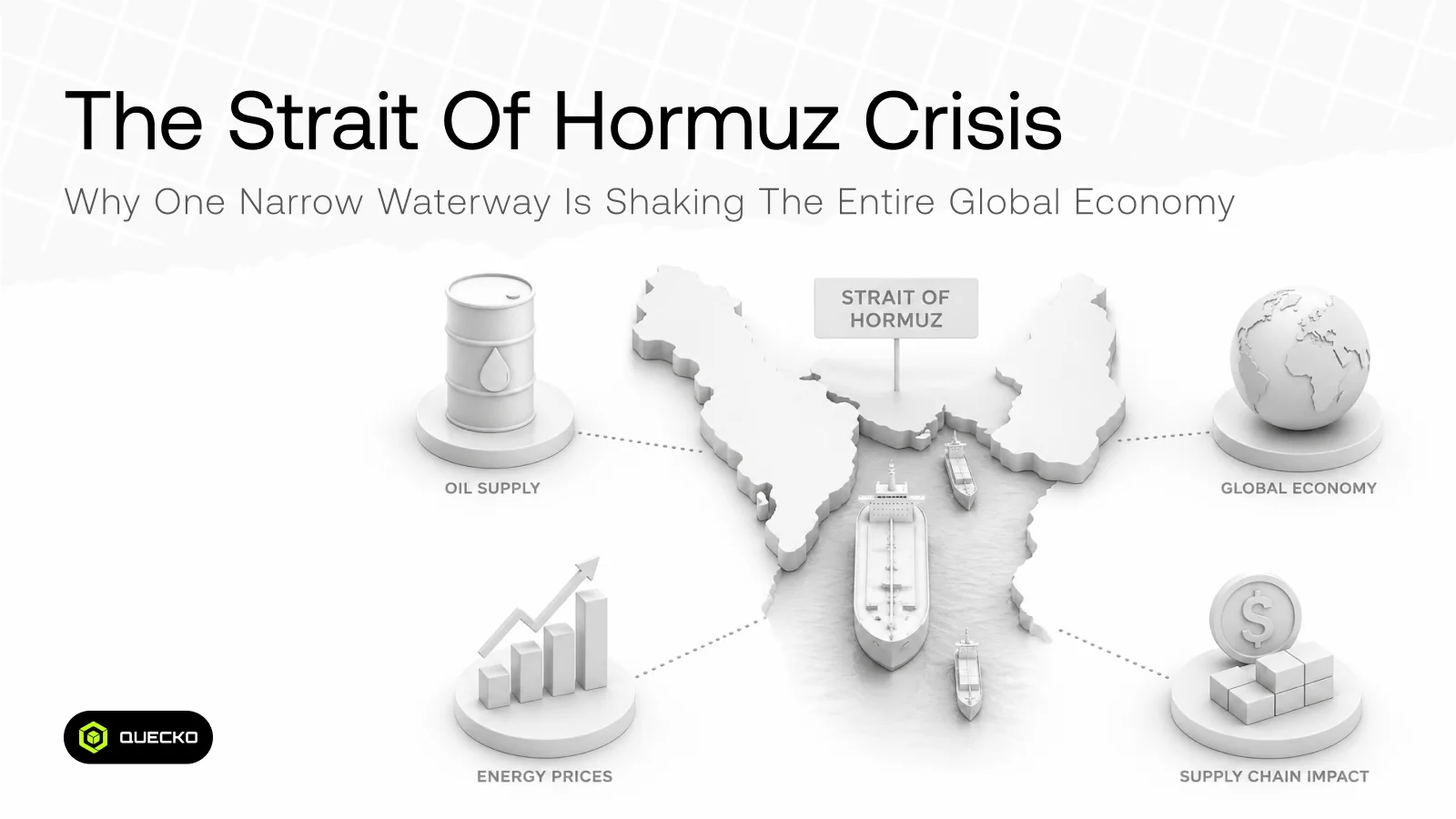
By 2026, a vast narrow stretch of water just 39 kilometers inland in the Middle East will be a center of global economic fluctuations The Strait of Hormuz, which connects the Persian Gulf to the Arabian Sea, is no conventional delivery route – it is miles away from a global digital energy hub, trade and commerce. As an important development for nations like Saudi Arabia, it has an important position to maintain the global oil supply and stabilize the oil markets, especially affecting parameters such as Brent crude oil.
As geopolitical tensions improve in open disputes, this critical choke point of strategic assets has turned into a global monetary fault line. Ripple effects are felt on every continent from disrupted delivery routes to skyrocketing oil tariffs to broken supply chains, rising inflation.
For blockchain innovators like Queco, the crisis highlights a powerful truth: centralized systems are fragile. In a global that is increasingly being shaped through geopolitical shocks, decentralized technology can also give way forward.
Understanding the Strait of Hormuz: A Global Lifeline
The Strait of Hormuz is widely regarded as the world’s most important marine cooling point. Approximately 20–25% of worldwide oil trade and vast quantities of liquid petroleum fuel (LNG), as well as liquid petroleum gasoline, pass daily through the UN Chamber of Commerce and Development (UNCTAD) through the medium.
Countries including Saudi Arabia, Iraq, Kuwait and the UAE are heavily dependent on it for oil exports, although Saudi Arabia has sought to reduce its threat profile through alternatives including the East West Pipeline. Meanwhile, major importers, including South Korea and various Asian economies, depend on those shipments to maintain trade and business growth and stabilize fuel costs.
But oil is not the best substance at stake. Fertilizers, chemicals and raw materials are also moving into the strait, and military turmoil is drawing global markets closer as Russian crude flows in. It wants to ripple away from energy and influence disconnected alternative routes like the Mekong as global distribution chains adapt to changing logistical pressures.
The 2026 Crisis: What Happened?
This primary disaster emerged as tensions over Iran and the empires rose, culminating in a naval war and the partial closure of the strait. Visibly drawing comparisons in vital global waterways as tankers on the Mekong River were stranded, and few vessels are unable to leave the Persian Gulf (CSIS), forcing key import-based international destinations, including South Korea, to urgently reconsider In some supply chains, shipping concerns with reduced capacity issues 95% of routes worldwide, which has been choked ( Japply Suppze) by Brent oil up sharply, and global energy shocks have intensified Results.
The disruption unsurprisingly revealed how deeply interconnected modern supply chains have become, even rapid fluctuations in unmarried offshore construction cause cascades in energy markets, shipping logistics, commercial production tanker insurance premiums soared, international cargo routes strategies opportunity, obstacles to stabilizing domestic markets Meanwhile, analysts warned that growing uncertainty in the region would reshape global trade flows, accelerate diversification away from energy dependence in the Middle East and increase funding for opportunistic transport corridors and renewable energy infrastructure.
One of the biggest power supply disruptions in modern history – similar to the oil crisis of the 1970s (Wikipedia) – billowed interest quotes with waves, heightened fears of a global recession, and new strategic cognition in opportunities such as rare earth mining to reduce energy conversion and homes.
Why is this crisis hitting the global economy?
The Strait of Hormuz crisis affects economic equipment worldwide, as this slender waterway handles about 5th part of the oil transportation in the region; any disruption there quickly ends in oil tariff hikes, worldwide inflation, increasing transportation charges, and growing uncertainties in the energy markets, which many economies can straightaway have global financial ripple effects.
1. Energy Shock and Oil Price Surge
When the distribution is tight in the system then depending on an oil cooling point, the charges react immediately.The Strait of Hormuz acts as a vital sea gateway for global energy flows, meaning even small disruptions allow shockwaves to ship through markets.
Oil prices rose over $100 a barrel, and projections reached excellent levels. (Wikipedia). The World Bank has predicted that power costs will increase by 24% by 2026 due to this disaster. (Reuters) The increase is driving up inflation, transport, manufacturing and household electricity prices across the world. It also puts pressure on key banks and impacts global interest rates as policymakers try to control inflation.
2. Inflation and Cost of Living Crisis
Rising electricity costs cascade across the board: higher fuel and fertilizer tariffs make food production more luxurious. ( The Wall Street Journal ) Developing countries have inflation rates greater than 5%, with growth slowing significantly. (Reuters) Countries like South Korea, which rely heavily on imported electric non-cooked products, are particularly vulnerable to getting caught up in a successful one, going through tighter family budgets and a decline in patronage spending.
For hundreds of many people, this means better payment for food, less energy purchases and financial worries.
3. Global Trade Disruptions
The strait is not always just energy routes – it is a transformation artery deeply connected to international shipping companies and distribution networks.
The global transportation delays disrupted distribution chains across industries. Manufacturing sectors dependent on uncooked materials – especially unprecedented investments in mining electronics and smooth electronics – face a slowdown in output. Trade-based economies with South Korea are particularly vulnerable as delays and shortages ripple through export-driven industries, including automotive and semiconductors.
4. Financial market volatility
Markets react sharply to uncertainty: inventory markets have reduced concerns about prolonged disruptions. (Wikipedia) Currencies in developing countries weakened. (United Nations Trade and Development (UNCTAD))
Analysts like Matt Smith should be aware that power supply risk typically causes economic volatility, especially when inflation is mixed with stress and tightened international interest spending.
Investors are moving to safe haven assets like gold and commodities. This volatility underscores the fragility of globally interconnected economic structures.
5. Food and Fertilizer Crisis
One of the most omitted impacts concerns food safety: fertilizer rates are estimated to shoot upward with the help of more than 30%. (Reuters) Farmers face extended production costs, reducing yields. ( The Wall Street Journal
Higher input costs additionally affect agricultural importers, such as South Korea, and increase reliance on global supply chains for strong food prices. The result is a global food crisis, especially in disadvantaged areas.
6. Digital Infrastructure at Risk
In addition to physical goods, the strait also includes underwater network cables, which handle 99% of the world’s net traffic. (Reuters)
Damage to those cables seeks to disrupt global communications, economic systems, and digital services, and every other level of threat. Businesses connected to distribution groups, logistics controllers, and international exchange platforms may also face operational disruption if connectivity is disrupted .
Meanwhile, volatility in power and commodity markets pushes additional focus on strategic sources, including unconventional mining, which can be essential for digital infrastructure and emerging technologies .
The bigger lesson: Focus is a weakness
The Strait of Hormuz disaster reveals a significant flaw in global structure: overrun at centralized choke points.
Whether by force, alternative, or fact, the focus on essential infrastructure in one area is a systematic threat.
This is where blockchain comes into the communication.
How Blockchain Can Mitigate Global Economic Risks?
Companies like Queco are building solutions designed to reduce reliance on centralized structures, especially technologies built using geopolitical factors, shifting alliances, fragile international infrastructure linked to actors with the U.S. Navy and the “US-Iran-Iran” scenario with broader dynamic, strategic war- geopolitical influence from individuals like Vladimir Putin.
1. Decentralized Finance (DeFi)
Traditional finance is closely dependent on centralized institutions, which are vulnerable to geopolitical shocks. Events such as Operation Epic Fury and the increasing frequency of neighborhood tensions surrounding the U.S.-Iran blockades and Hormuz highlight how quickly economic systems can be disrupted. Blockchain enables peer-to-peer economic systems to operate independently of borders and intermediaries, reducing exposure to flaws centralized in existing security infrastructure frameworks.
2. Tokenization of Real-World Assets
In downturns, buyers seek stability. Tokenized items, including gold-backed tokens, offer:
- Transparency
- Stability
- Global Accessibility
This is consistent with the evolving changes near real asset integration in blockchain ecosystems, especially when traditional markets are affected by war-driven uncertainty, sanctions, or the use of disrupted trade routes.
3. Supply Chain Transparency
Blockchain can create immutable records of the movement of goods, helping companies:
- Monitor real-time disruptions of geopolitical events or demining activities in conflict zones
- Optimize Logistics Through Crises Regarding Areas Affected by U.S.-Iran and Hormuz Closure Threats
- Reduce fraud across global enterprise networks strained through fluctuations in activity paying tribute to the technological disruptions of the Iran-Iraq War
In a disrupted global trade environment created through mobile alliances and maritime security interventions involving the U.S. Navy, this will be invaluable in maintaining resilience and cohesion.
4. Decentralized Data Infrastructure
With an increasing number of undersea cables and physical structures exposed to risk, decentralized data storage and communications systems can provide flexibility Modern challenges and strategic protection planning, from mine-clearing operations to evolving international digital security architecture strategies, Web3 highlights the need for system availability decreases levels in international relations, ensure the integrity of records even under the influence of geopolitical tensions with the help of state actors and contested maritime territories.
Why Does This Matter for Businesses and Investors?
The Strait of Hormuz disaster is not just a geopolitical problem, it is a call for attention.
It shows that:
- Global systems are deeply interconnected.
- Disruption in one area can have global consequences
- Agility requires decentralization .
It is no longer imperative for organizations to adapt to this new reality.
Quecko’s Role in the New Digital Economy
As a blockchain development and advertising agency, Queco has been at the forefront of this transformation.
By helping organizations adopt blockchain technology, Queco enables:
- More transparency
- Increased Protection
- Better resilience to global disruptions
These talents became important in a time colored by uncertainty.
The Future Outlook: What Comes Next?
The subsequent crisis in the Strait of Hormuz may also subside, but its consequences will fade.
Key trends in observation:
- Variety of electrical paths
- Increased investment in renewable energy
- Deployment of Decentralized Technology
- More geopolitical fragmentation
Even if the strait were to reopen at all costs, the world would already see how fragile its systems are.
Conclusion
The Strait of Hormuz is more than just a thin waterway, it is the backbone of the global economic system.
Prompted by its dissolution:
- Energy Crisis
- Inflation rising
- The supply chain broken
- Financial instability
But beyond the on the spot effect, it has discovered the deeper reality that centralized structures are unable to weather the geopolitical shocks of today.
This is where blockchain, and groups like Queco, provide transformative solutions – creating a decentralized, resilient, and future-ready international economic system .
Frequently Asked Questions (FAQs):
1. Why is the Strait of Hormuz so important?
As it comprises about 20–25% of the region’s oil and bulk LNG supplies, making it important in international electricity markets.
2. How does the crisis affect ordinary people?
This results in improved gas prices, accelerated food price lists, inflation, and possible lack of business due to the financial downturn.
3. What caused the 2026 Strait of Hormuz disaster?
Rising geopolitical tensions and disputes over Iran and the Empire partially blocked and disrupted distribution channels.
4. Can global financial instruments get better faster?
While healing depends on how quickly the strait reopens and geopolitical tensions ease, long-term impacts could also persist.
5. How can blockchain help during such crises?
Blockchain reduces reliance on centralized systems, improves transparency, enables decentralized finance, and supports chains.
6. What is Quecko’s position in this space?
Quecko enables enterprises to adopt blockchain responses to increase resilience, sustainability, and efficiency in a risky international environment.
7. Will such crises recur?
Well, as long as worldwide systems rely on essential choke points, comparable disruptions are still a good option.
Author

Sheeba Abbasi
Digital Marketer and Social Media StrategistHi! I'm Sheeba Abbasi, a Digital Marketer, Social Media Strategist, and Content Creator specializing in Web 3.0 and Blockchain, with expertise in content development, community engagement, strategic planning, and technical writing.

Date
7 months agoShare on