QUANTUM COMPUTING’S $3 TRILLION THREAT TO CRYPTO
A new report says $3T in crypto is quantum-vulnerable. Here’s the real Q-Day timeline, how Bitcoin, Ethereum, and others are responding, and what post-quantum cryptography looks like right now.
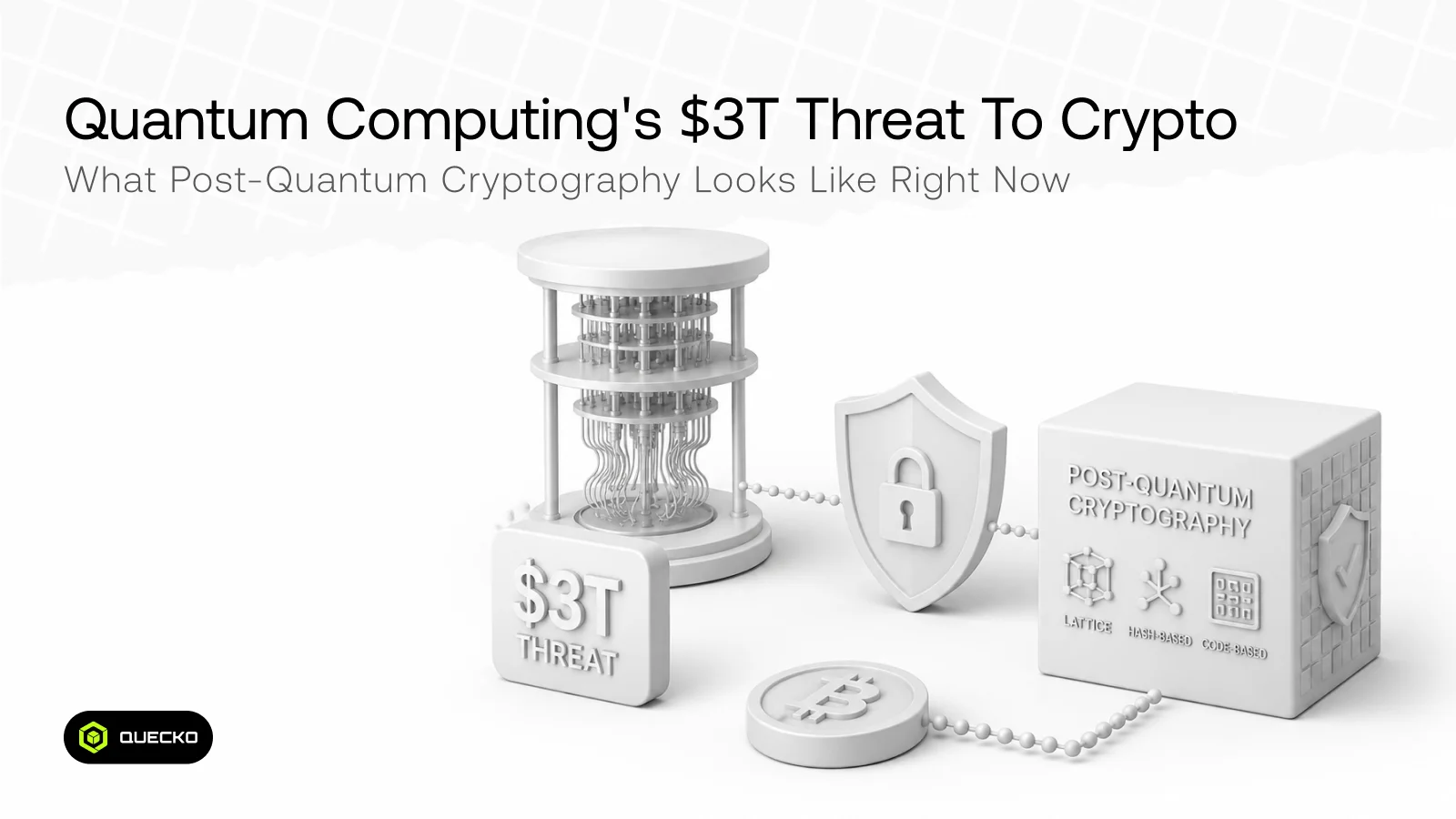
On May 9, 2026, Project Eleven, a post-quantum security firm whose CEO had just shared a stage at Consensus Miami published a 110-page report with a number designed to stop you mid-scroll: more than $3 Trillion in digital assets secured by elliptic curve cryptography could become vulnerable to quantum attacks within 4 to 7 years.
The number is not hyperbole. It is the aggregate value of the entire digital asset industry: Bitcoin, Ethereum, stablecoins, every token built on top of them, secured by precisely the same class of cryptographic primitive that quantum computers are specifically designed to break.
The report’s most uncomfortable line is not the dollar figure.
It is the diagnosis of why fixing it is so hard: ‘The gap is not technical.’
That is the sentence this blog is built around.
The cryptographic fix for quantum vulnerability exists today, standardized, tested, and ready to deploy. What doesn’t exist is the coordination to deploy it across a financial system that was never designed for emergency-speed upgrades.
This piece walks through exactly where that gap stands in June 2026, what the threat actually is, how each major blockchain is responding, what the real financial system stakes are beyond crypto, and what you should actually do about it.
What Exactly Is the Quantum Threat to Crypto?
Forget the jargon and the threat is mechanically simple.
Every Bitcoin or Ethereum wallet has two keys: a private key that proves ownership, and a public key derived from it that anyone can see on the blockchain. The entire security model rests on one mathematical assumption, that you cannot “reverse-engineer” the private key from the public key in any reasonable amount of time using classical computers.
Shor’s Algorithm, a quantum algorithm published in 1994, breaks that assumption. A sufficiently powerful quantum computer running Shor’s Algorithm can derive a private key from a public key, allowing an attacker to forge signatures and take control of funds. The algorithm has been understood for over 30 years. What has changed is how close quantum hardware is getting to running it at the scale required.
$3T+ in digital assets secured by elliptic curve cryptography that Project Eleven’s May 2026 report identifies as exposed to quantum risk
20× reduction in the quantum resources needed to break Bitcoin’s encryption, per Google’s March 2026 whitepaper; fewer than 500,000 physical qubits, down from 13 million
9 min the time Google estimates a sufficiently powerful quantum computer could take to crack Bitcoin’s cryptography; one minute faster than Bitcoin’s average block time
That last figure deserves a moment of context.
Google’s March 2026 paper, co-authored with researchers from Stanford, UC Berkeley, and the Ethereum Foundation, didn’t just lower the qubit estimate, it modeled a ‘primed’ attack scenario where part of the computation happens before a transaction is even broadcast.
Under that model, once your public key appears in the mempool, an attacker could theoretically complete the remaining work in roughly 9 minutes, inside Bitcoin’s 10-minute average block confirmation window.
That specific number is what moved the conversation from ‘distant theoretical risk’ to ‘something with an actual operational timeline.’
Crucially, no machine capable of this exists today.
Current quantum hardware has hundreds of noisy, error-prone qubits. Scaling to a stable 500,000 physical qubits with error rates low enough to run Shor’s Algorithm reliably is, in the words of multiple researchers, an engineering Everest. The disagreement in the field is not about whether this is hard.
It is about how many years of hard work remain.
When Is ‘Q-Day’?
Q-Day, the moment a cryptographically relevant quantum computer (CRQC) can reliably break current public-key cryptography is the single most contested number in this entire field. Different credible institutions land on meaningfully different estimates, and the spread itself tells you something important about how uncertain this still is.
| Source | Estimate | Basis |
| Project Eleven (May 2026) | 2030–2033 baseline | 110-page resource modeling report; CEO Alex Pruden, Solana Foundation collaboration |
| Global Risk Institute (2026) | 19–34% probability by 2034 | Annual Quantum Threat Timeline, cited in Citi Institute report |
| Google (March 2026) | 2029 internal deadline | Self-imposed migration target for Google’s own infrastructure, not a CRQC prediction |
| Mosca & Piani Survey | >50% by late 2030s | Expert survey aggregation; meaningful probability by mid-2030s |
| Project Eleven (pessimistic) | 2042 | Conservative scenario within the same report’s range |
The range, anywhere from 2029 to 2042 depending on the source and the scenario is wide enough that reasonable people disagree about urgency.
But notice what doesn’t vary across any of these estimates: every single one falls within the operational lifespan of assets, contracts, and data that exist today.
A migration that takes 7 to 10 years, starting from a Q-Day estimate of 2030–2033, needs to have started already.
“Our analysis suggests that, based on current trends, Q-Day is more likely to occur than not by 2033, and potentially even as soon as 2030. The window for the world to migrate to post-quantum cryptography is narrowing.”
— Project Eleven, 110-Page Quantum Threat Report, May 2026
The Threat That’s Already Active: Harvest Now, Decrypt Later
Here is the part of this story that should concern you regardless of which Q-Day estimate you believe, because it doesn’t depend on quantum computers existing yet.
“Harvest now, decrypt later” (HNDL) is the strategy of capturing encrypted data today and storing it indefinitely until quantum hardware exists to decrypt it.
NEAR Protocol co-founder Illia Polosukhin, a former Google AI researcher, put it bluntly in May 2026 coverage: ‘If I know quantum computers are coming in a couple of years, I will start trying to capture all possible data that’s going around. Everything we’re putting on the internet, if you’re identifiable as a person of interest, you can assume will be decrypted in two years. It’s most likely happening already.’
For crypto specifically, this changes what ‘safe’ means. Project Eleven’s analysis identifies a wire-level surface that’s broader than wallet keys alone, encrypted interbank messages, exchange authentication data, and custodian signing infrastructure are all being transmitted and potentially harvested right now.
Ethereum has begun a coordinated post-quantum migration. Google is targeting 2029 for its own transition. Bitcoin, and the major crypto exchanges and custodians where most signing traffic actually lives, have not publicly committed to comparable protections for their wire-level infrastructure.
This is also where the AI angle compounds the timeline pressure. Security researchers told CoinDesk in May 2026 that AI is actively being used to optimize quantum error correction, one of the field’s biggest engineering bottlenecks.
Project Eleven’s CEO confirmed it directly: ‘AI is definitely being used to accelerate the development of quantum computing.’ Separately, AI models are increasingly effective at finding implementation bugs in cryptographic code, and in some cases, identifying weaknesses in the cryptography itself.
The same week this dynamic was being discussed, an AI model uncovered a four-year-old flaw in Zcash that could have enabled unlimited token issuance, a preview of how AI-discovered vulnerabilities and quantum-accelerated cryptanalysis might compound rather than arrive separately.
How Is Each Major Blockchain Actually Responding? A Real Breakdown
This is where the conversation moves from theory to engineering and where the gap between blockchains becomes genuinely stark. Some networks have shipped production code. Others have a published roadmap. At least one major chain has nothing at all.
| Network | Status | Approach | Biggest Risk |
| Bitcoin | Testnet (early 2026) | BIP-360 (Pay-to-Merkle-Root addresses), BIP-361 (legacy signature sunset), SPHINCS+/FALCON candidates | Governance speed — 7yr migration est. vs. decentralized consensus culture |
| Ethereum | Roadmap published (Feb 2026) | Four-layer ‘Strawmap’: leanXMSS signatures, leanVM (250x compression), recursive STARKs, EIP-8141 account abstraction | Execution — ~7 hard forks required; Glamsterdam and Hegota confirmed for 2026 |
| Algorand | Shipped (Nov 2025) | First Falcon-signed payment live on mainnet; Falcon signatures at ~1.3KB, minimal overhead | Lowest — already in production with no fee or latency impact observed |
| Solana | Experimental | Quantum-safe vaults (optional, hash-based one-time signatures); Project Eleven partnership announced | Opt-in only — no base-layer mandate yet |
| QRL | Built quantum-resistant from genesis | XMSS (eXtended Merkle Signature Scheme) for every address, every transaction | Liquidity — strong tech, thin trading volume ($63K–$112K daily) |
| BNB Chain | No published roadmap | None confirmed; Founder publicly downplayed urgency in March 2026 | Highest exposure — largest market cap chain with zero concrete PQ preparation |
Bitcoin’s situation is the most structurally interesting because cryptography is the easy part.
Ethereum co-founder Vitalik Buterin’s February 2026 roadmap identifies 4 distinct vulnerable layers:
- Consensus-level BLS signatures
- KZG-based data availability
- ECDSA account signatures
- Zero-knowledge proofs
and proposes a four-year, roughly seven-hard-fork migration. That is an enormous coordination project, but Ethereum’s governance culture has executed major protocol changes on a multi-year cadence before.
Bitcoin’s governance culture has not.
Independent security researcher Ethan Heilman estimates a full Bitcoin migration to quantum resilience would take 7 years from the day consensus actually forms, and consensus forming is the hard part.
SegWit took 8.5 years from concept to widespread adoption.
Taproot took 7.5 years.
If a Q-Day estimate of 2030–2033 is correct, and Bitcoin needs 7 years from consensus, the math is uncomfortably tight even under optimistic assumptions about how quickly the community could agree.
There is also an unresolved political question layered on top of the technical one: what happens to the roughly 1.1M BTC believed to be dormant in Satoshi Nakamoto’s original wallets, alongside the broader 6.9M BTC sitting in addresses with exposed public keys, nearly 1/3rd of Bitcoin’s total circulating supply. Some proposals, like the experimental ‘Hourglass‘ concept, would gradually restrict spending of unmigrated coins to create a forcing function. Others argue any intervention into dormant coins violates Bitcoin’s core ethos of minimal intervention. Heilman has noted this governance question may prove more contentious than the cryptography itself.
The Tools Already Exist: What Are NIST’s Post-Quantum Standards?
It’s worth being precise about what is and isn’t solved here, because the report’s central claim ‘the gap is not technical’ only makes sense once you see how complete the cryptographic toolkit already is.
After a 6-year evaluation involving 82 candidate algorithms from research teams across 25 countries, NIST finalized three post-quantum cryptography standards in August 2024, with a fourth added in March 2025:
- FIPS 203 (ML-KEM, formerly CRYSTALS-Kyber) — key encapsulation for secure key exchange, the PQC replacement for RSA and ECDH
- FIPS 204 (ML-DSA, formerly CRYSTALS-Dilithium) — lattice-based digital signatures, the primary replacement for ECDSA
- FIPS 205 (SLH-DSA, formerly SPHINCS+) — hash-based signatures, intended as a conservative backup with different security assumptions than lattice-based schemes
- HQC (selected March 2025) — an additional key encapsulation mechanism providing algorithmic diversity in case weaknesses are found in lattice-based approaches
These run on classical hardware available right now.
Chrome already supports ML-KEM for hybrid key exchange. AWS, Azure, and Google Cloud are all PQC-capable today. The algorithms are public, tested through six years of adversarial cryptographic review, and free to implement.
Algorand’s production of Falcon signatures and the testnet activity around Bitcoin’s BIP-360 are proof that this isn’t vaporware, it’s engineering that works, waiting for coordinated deployment.
The catch, and this is the part every per-chain breakdown above illustrates, is size and speed.
Post-quantum signatures are meaningfully larger than the ECDSA signatures they replace. a Falcon signature runs about 1.3KB, and SPHINCS+ signatures can be significantly larger still.
The Coinbase quantum advisory board has flagged this directly: the transition is not a simple algorithmic swap. It’s a complex engineering problem with real consequences for blockchain storage requirements, bandwidth, and transaction fees at scale.
Beyond Crypto: Why Citi Just Put a $3.3 Trillion Price Tag on This
This is the part of the quantum threat story that almost no crypto-native coverage connects to the blockchain conversation and it’s the reason this isn’t just a crypto problem wearing a crypto hat.
In February 2026, the Citi Institute modeled what a single quantum-enabled cyberattack on a major US bank could actually cost the broader economy.
Their scenario: a one-day disruption to a top 5 US bank’s access to the Fedwire Funds Service, the Federal Reserve’s real-time interbank payment system, could generate between $2 trillion and $3.3 trillion in cascading economic damage, equivalent to a 10% to 17% decline in real US GDP.
Read that again.
That is not a crypto market cap figure. That is Citi’s own modeling of what happens to the traditional financial system if its cryptographic foundations fail for even a single day. The mechanism is identical to what threatens Bitcoin and Ethereum, the same elliptic curve and RSA-based public-key cryptography that secures interbank messaging, transaction settlement, identity verification, and secure communications across the entire financial system.
Crypto isn’t uniquely exposed. It’s simply the most visible, most publicly auditable instance of a vulnerability that runs underneath the entire global economy.
Citi’s report explicitly challenges the idea that all crypto assets face equal risk, and argues the primary danger right now isn’t a future quantum computer at all. It’s the harvest-now-decrypt-later attacks already described above, which make long-lived financial, government, and personal data vulnerable years before any quantum computer reaches full capability.
The timeline for action, Citi argues, isn’t driven by when quantum computers arrive. It’s driven by the shelf life of the data you’re trying to protect.
“A single quantum-enabled cyberattack on a major U.S. bank could trigger trillions of dollars in economic damage — reframing quantum computing from a distant research concern into an immediate financial stability risk.”
— Citi Institute, February 2026
Regulators are responding accordingly, not abstractly.
US federal agencies are expected to begin migrating high-risk systems to post-quantum cryptography by 2030, with full adoption targeted by 2035.
European national strategies are required by the end of 2026, with high-risk systems transitioning by 2030.
Canada has set deadlines requiring federal departments to submit migration plans by April 2026. Central banks are issuing directives requiring institutions to formally assess and manage quantum-related cyber risk.
As Citi’s analysts put it, the conversation has shifted from awareness to execution — quantum readiness is moving from a technical discussion into the boardroom, framed as an operational and governance issue rather than a research curiosity.
What Should You Actually Do?
If You Hold Crypto Directly
Your exposure depends entirely on whether your public key has ever been exposed on-chain. If you’ve never sent a transaction from an address meaning only your public key hash, not the public key itself, is visible, your exposure is structurally lower.
The moment you spend from that address, the public key becomes visible and the clock theoretically starts.
- Avoid address reuse. Every time you reuse an address, you keep its public key visible on-chain indefinitely.
- Move funds from legacy address formats (particularly old Pay-to-Public-Key addresses) to modern formats as post-quantum options become available on your chain of choice.
- Follow your wallet provider’s communications about post-quantum support — this is becoming a genuine differentiator between custodians.
- For genuinely long-term cold storage, prioritize chains with a credible, funded post-quantum roadmap (Ethereum, Algorand) or built-from-genesis quantum resistance (QRL) over chains with no public roadmap.
If You’re a Web3 Builder or Protocol Developer
- Audit every cryptographic dependency in your application and smart contract layer, specifically every use of ECDSA, secp256k1, or Ed25519 operations.
- Design for cryptographic agility from day one. Build your application so signature schemes can be swapped without a full protocol rebuild, Ethereum’s EIP-8141 account abstraction proposal is the clearest example of this principle implemented at the protocol level.
- If you’re building on a chain with no published PQ roadmap (the BNB Chain situation above), treat that as a genuine architectural risk in your own due diligence, not a problem for someone else to solve later.
- Track NIST’s standards directly rather than waiting for your blockchain’s governance process, ML-DSA (Dilithium) and SLH-DSA (SPHINCS+) are implementable today regardless of what your base layer eventually decides.
If You’re an Enterprise or Financial Institution
- Treat this as a board-level governance issue now, not a future IT ticket, Citi’s own framing is that the conversation has already moved from awareness to execution among regulated peers.
- Commission a cryptographic asset inventory specifically covering wire-level signing infrastructure, interbank messaging systems, and any blockchain-adjacent custody operations, this is the surface Citi and Project Eleven both flag as broader and less-discussed than wallet keys alone.
- Engage with your central bank or regulator’s published timeline directly. The US, EU, and Canadian deadlines referenced above are not abstract, they create cascading compliance pressure through supply chains regardless of your jurisdiction.
- If you custody or transact in digital assets on behalf of clients, your quantum-readiness posture is becoming a genuine competitive and trust differentiator, not a back-office detail.
The Honest Summary: This Is Solvable.
Strip away the noise and three things are simultaneously true. The cryptography to fix this exists, is standardized, and runs on hardware available today, NIST settled that question in August 2024.
The threat is not a hypothetical future waiting patiently for headlines, harvest-now-decrypt-later attacks mean any sufficiently sensitive data encrypted today is already part of the exposure calculation, regardless of when a CRQC actually arrives. And the gap between those two facts is almost entirely about coordination, not invention.
That is precisely why the responses documented above vary so widely.
Algorand shipped production code in November 2025 because its governance allowed it to move fast.
Ethereum published a detailed four-year roadmap because its culture tolerates frequent, scheduled hard forks.
Bitcoin is debating the question because its governance culture is deliberately, structurally resistant to fast unilateral change, the same property that makes it trustworthy as money makes it slow to respond to existential technical threats.
BNB Chain has done essentially nothing, and its own co-founder has publicly downplayed the urgency.
Project Eleven’s diagnosis : ‘the gap is not technical‘ is the sentence to remember from all of this. It reframes the entire conversation. The question is no longer whether humanity knows how to build quantum-resistant financial infrastructure.
We do.
The question is whether the institutions managing $3 trillion in digital assets, and the trillions more in traditional finance running on identical cryptographic assumptions, can coordinate fast enough to deploy what already exists before the timeline runs out.
Nobody is saying your crypto is at risk today.
No quantum computer capable of this exists.
But ‘nobody is at risk today‘ and ‘we have time‘ are different sentences, and the data above suggests the gap between them is narrower than most portfolios, most protocols, and most institutions are currently planning for.
At Quecko, we build Web3 infrastructure designed with cryptographic agility in mind, because the chains and protocols that can adapt fastest to standards like ML-DSA and SLH-DSA will be the ones still trusted with real value when Q-Day stops being a debate and starts being a deadline. If you are thinking about post-quantum readiness for your protocol, product, or institution, we would like to talk.
quecko.com | Blockchain · AI · Product Engineering
Frequently Asked Questions
Is my crypto actually at risk right now?
Not from a quantum computer that exists today — none capable of breaking current encryption exists yet. The real near-term risk is harvest-now-decrypt-later attacks, where encrypted data is collected today for decryption once quantum hardware matures. If your assets have never had their public key exposed on-chain (no transactions sent from the address), your exposure is structurally lower. Once you spend from an address, the public key becomes visible, and that’s the specific vulnerability quantum computers target.
What is Project Eleven’s $3 trillion report actually claiming?
Published May 9, 2026, the 110-page report estimates that over $3 trillion in digital assets secured by elliptic curve cryptography could become vulnerable within four to seven years, with a baseline Q-Day estimate of 2030–2033. Its core argument isn’t about the technology gap — it explicitly states ‘the gap is not technical.’ The challenge is coordinating a simultaneous migration across users, exchanges, custodians, wallet providers, and miners, which the report says could take five to over ten years depending on system complexity.
Which blockchain is best prepared for the quantum threat?
Algorand is currently the furthest along among major chains, having shipped a production Falcon-signed payment on mainnet in late 2025. Ethereum has the most detailed roadmap (a four-year, roughly seven-hard-fork plan published February 2026) but hasn’t shipped the core changes yet. Bitcoin has testnet activity around BIP-360 and BIP-361 but no binding protocol commitment, and faces a governance culture that historically takes 7–8.5 years to execute major changes. QRL was built quantum-resistant from its first block but has thin trading liquidity. BNB Chain, despite being one of the largest chains by market cap, has no published post-quantum roadmap at all.
What is ‘harvest now, decrypt later’ and why does it matter more than Q-Day itself?
It’s the strategy of capturing encrypted data today and storing it until quantum computers powerful enough to decrypt it exist. It matters more than the Q-Day debate because it means the threat doesn’t wait for quantum computers to arrive — the data theft happens now, the decryption happens later. For crypto, this extends beyond wallet keys to exchange authentication data, custodian signing infrastructure, and interbank messaging. Citi’s February 2026 report frames this as the dominant near-term risk, arguing the real timeline for action is driven by how long your sensitive data needs to stay protected, not by when a quantum computer is built.
What are the NIST post-quantum cryptography standards?
NIST finalized three standards in August 2024 after a six-year evaluation: FIPS 203 (ML-KEM, for key exchange), FIPS 204 (ML-DSA, for digital signatures — the main ECDSA replacement), and FIPS 205 (SLH-DSA, a hash-based signature backup). A fourth algorithm, HQC, was added in March 2025 for algorithmic diversity. These all run on existing classical hardware today — no quantum computer required to deploy them. Chrome, AWS, Azure, and Google Cloud already support PQC implementations. The technology is ready; the deployment coordination across legacy systems and decentralized networks is what’s lagging.
Why is this also a threat to traditional banking, not just crypto?
Because banks, exchanges, and government systems rely on the exact same vulnerable cryptography — RSA and elliptic curve algorithms — to secure interbank messaging, payment settlement, and digital identity. Citi’s February 2026 report modeled a single quantum-enabled attack on one top-five US bank’s access to the Fedwire payment system, estimating $2 trillion to $3.3 trillion in cascading economic damage, equivalent to a 10–17% decline in US GDP. Crypto is simply the most publicly visible and auditable instance of a vulnerability that runs underneath the entire global financial system.
Author

Hira Asif
Blockchain Enthusiast | Exploring the future of Web3 through research, strategy, and storytelling.Hira writes about blockchain infrastructure, geopolitics, and the business of Web3, with a bias toward analysis over headlines. As Web3 Growth and Content Strategist at Quecko, she shapes how a 120-engineer Web3 development firm communicates with founders, builders, and institutional audiences globally. Her work covers stablecoins, AI agents, quantum risk, and the structural forces reshaping crypto markets over time.

Date
5 months agoShare on